Our Vision
Design pioneering solutions that achieve the regeneration of natural, human, and urban ecosystems on a global scale.
Last updated:
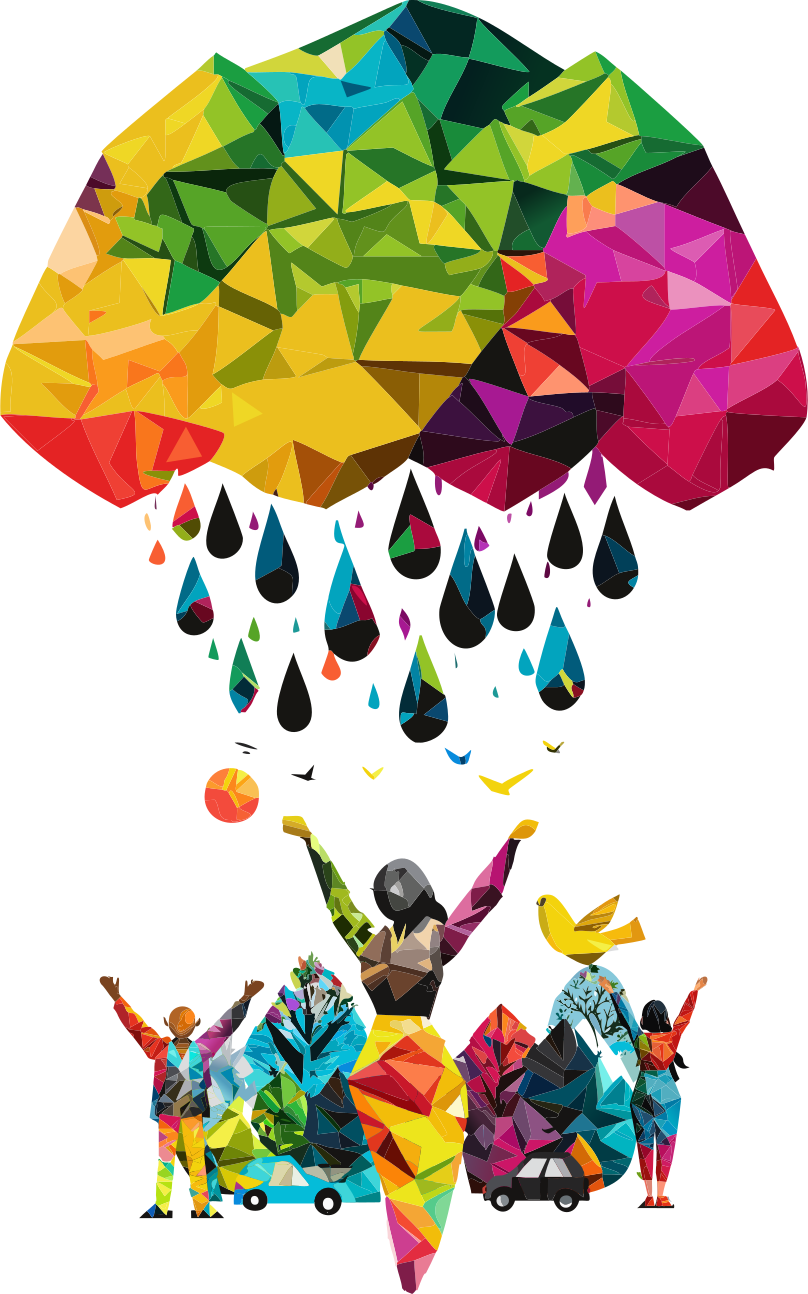
Our world is changing, faster and faster. A thousand years ago, we were fully subject to the complex system of nature. Today, our species has taken over the globe, creating human and urban ecosystems that put increasing pressure on themselves and the natural systems that sustain them. We are rapidly approaching tipping points that could cause irreparable damage — with the survival of humankind on the line, at least as we know it today.
It is time for a change in how we do things.
Let us tell you why
From isolated practices towards a complex systems approach
Social, urban, and environmental challenges are often described as “wicked problems” — complex, interconnected, and unpredictable. Traditional, linear approaches to innovation frequently fall short, sometimes even making things worse. A systems approach offers a holistic perspective, recognizing that changes in one part of a system can have unforeseen impacts on others. It embraces complexity and finds strength at the intersection of chaos and order.
This matters for issues like climate change, social inequality, and global health crises — problems that span multiple domains and arise from intricate interactions among social, environmental, and economic factors. By fostering innovation and collaboration across sectors and disciplines, a systems approach breaks down the silos that hinder effective solutions. Considering diverse viewpoints and expertise, it leads to more comprehensive, resilient, and regenerative outcomes — allowing us to better understand and respond to the dynamic challenges of our time.
From sustainability towards regeneration
Sustainability suggests maintaining a balance between the positive and negative impacts of our activities, often aiming for climate neutrality or net-zero strategies. But what if that balance is insufficient? What if we are so far out of bounds that we cannot prevent planetary boundaries from being exceeded? We already see the consequences — nature is suffering, vast areas are becoming uninhabitable, and species are going extinct. It is a reality many are just beginning to grasp.
Regeneration seeks not just to maintain balance but to restore, regenerate, and enhance the intrinsic value of ecosystems. It aims for positive feedback loops and the self-organization of systems toward a desired state. Rather than simply extracting fewer resources, regeneration focuses on human well-being, the restoration of nature and biodiversity, and the creation of livable urban spaces where humans and nature coexist. The concept offers a way forward, even in the face of dire predictions. Successful projects — like the half-moon ditches dug across the barren Sahel to combat desertification — demonstrate its potential.

Regenerative Innovation Systems
The idea behind Regenerative Innovation Systems is to foster systems that are inherently resilient, adaptable, and capable of evolving to meet changing needs and challenges. While the concept is relatively new and still under-defined in academic literature, there is a growing body of work on regenerative thinking and business practices. Notably, Carol Sanford has outlined guiding principles, though regenerative innovation systems as a concept require further exploration. The concept of regenerative systems, however, is more established when applied to natural, urban, and human ecosystems.
Natural Ecosystems
In natural ecosystems, regenerative agriculture has long been a method for growing crops without fertilizers while improving soil health and increasing yields. But regeneration extends far beyond farming — it encompasses the restoration of entire ecosystems from the ground up. Every solution that strengthens nature is, by its very nature, regenerative.
Human Ecosystems
In human ecosystems, regeneration is tied to well-being — encompassing not just jobs, homes, and physical health, but also community, purpose, and access to nature. Universal basic income is one example of a regenerative solution, showing positive effects on mental and physical health, family relations, job searches, and volunteerism, all while reducing government spending on costly services like debt counseling. Countless such solutions exist, each creating ripple effects across the wider system.
Urban Ecosystems
In urban ecosystems, natural and human systems coexist. The challenge is to make both thrive, creating livable habitats with global impact. Regenerative solutions include locally owned sustainable energy systems, clean water access, circular use of materials, climate resilience, and clean shared mobility. For example, bidirectional charging of shared vehicles helps balance local renewable energy systems, provides clean mobility, reduces the number of parked vehicles, and frees up space for nature to return. Urban regeneration is not only possible — it is essential.
Regen Studio
At Regen Studio, we choose our projects carefully, accepting only those with potential for regeneration in natural, urban, or human ecosystems. We see ourselves as designers — crafting processes to identify challenges, generate ideas, develop prototypes, validate solutions within ecosystems, and test them in real-life situations. We also aim to contribute to the field by expanding knowledge on regenerative innovation systems.
We do not work alone. Our expertise lies in bringing people together around a common challenge and providing a clear, concrete path to solving it. We guide you and your innovation ecosystems through the complex process of change — toward solutions that achieve regeneration within our lifetimes and on a global scale.
Let's Create Together
Ready to explore regenerative innovation?
Tell us about your challenge and we'll find the path to regeneration together.