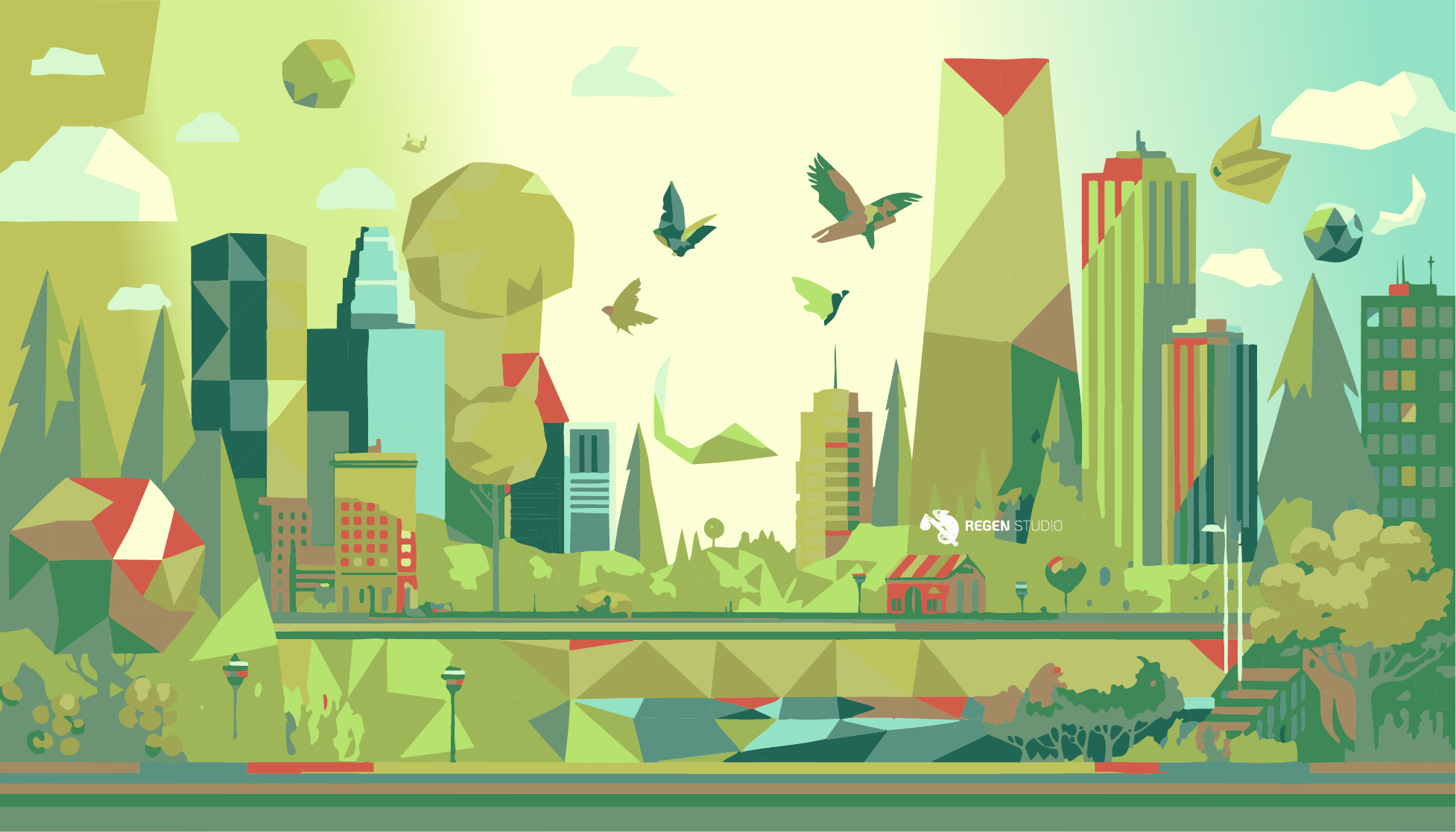
Ben Wilson’s Urban Jungle challenges us to rethink our relationship with urban environments, presenting cities as dynamic ecosystems capable of fostering biodiversity and resilience in harmony with humans and the built environment.
Ben Wilson’s book Urban Jungle: Wilding the City challenges us to rethink our relationship with urban environments, presenting cities as dynamic ecosystems capable of fostering biodiversity and resilience in harmony with humans and our built environment.
This book takes readers on a journey across history and modern practice, exploring how urban areas can transform from concrete jungles into thriving, regenerative landscapes.
Our Key Takeaways for Regenerative Urban Ecosystems
- Rewilding the Urban Fabric — Wilson emphasizes the potential of cities to integrate natural systems. By converting abandoned spaces into urban wilderness, cities can become biodiversity hotspots, contrary to the popular belief that cities are by definition deprived of nature.
- Natural Resilience — A transition from ‘grey to green’ offers tangible benefits. A city rich in nature is better equipped to prevent climate shocks, such as cooling urban heat islands during heat waves, improving air quality in dry seasons, or providing protection from flooding. Moreover, green cities have a measurable positive outcome on human mental and physical health.
- Urban Microclimates for Survival of Species — Urban areas are diverse and wide-ranging. Some areas are relatively stable in temperature, humidity, or other environmental conditions; others have more variety, sometimes depending on the human activity shaping that area. This can create localized climates that support a diverse range of species. Shade-providing trees, water features, and green corridors provide essential habitats.
- Circularity and Resource Management — Wilson argues for cities to function as closed-loop systems. By implementing bold strategies to reduce material consumption and prioritizing recycling, repairing, and reusing, cities can reduce their global impact on other biomes, and with regenerative practices might even strengthen biodiversity whilst producing resources.
- Zootropolis — Co-creating Nature with Nature — Where native plants often struggle to thrive in altered city climates, Wilson suggests embracing non-native species that thrive in these unique urban climates, and even actively introducing some that can assist in creating functional urban ecosystems. This last takeaway reveals how much we have yet to do on urban ecology ethics.
Inspiring Examples from Around the World
- Berlin: Nature Reclaims the City — In post-war Berlin, abandoned and damaged urban infrastructures were reclaimed by nature, first by pioneering ‘ruderal’ species — often non-native, emerging from the rubble of an intercontinental warzone. Later, those areas became biodiversity havens. From 1957, Scholz and Sukopp laid down the basis for what has become urban ecology, through their documentation of Berlin’s natural ecosystem, which with additional human shaping has become more biodiverse than its surrounding biome.
- São Paulo: Reviving the Atlantic Forest — According to the UNFCCC, São Paulo is leading the way in climate resilience through water system improvements and extreme weather events protection. A notable individual is Hector da Silva, who single-handedly reforested 40,000 trees to regenerate a degraded and polluted area in the middle of a rough part of the city. Today this place is acknowledged by the city government as the Linear Park. These efforts showcase how megacities can preserve biodiversity while enhancing residents’ quality of life.
- Amsterdam: A Circular City Vision — Amsterdam has become the first city to adopt the goal of becoming a fully circular city, aiming to achieve it by 2050. Using the well-known Global Doughnut economic framework by Kate Raworth, they ‘un-pave’ the way for cities to become closed loops that prevent negative impact on biomes across the world.
Relevance to Regen Studio
At Regen Studio, our projects align closely with Wilson’s vision of regenerative cities. Whether through creating sustainable systems for Digital Product Passports or collaborating on urban greening initiatives, we aim to design solutions that honor the interconnectedness of natural and human systems.
Practices for Regenerative Innovation
From Urban Jungle, we can extract several actionable practices for creating regenerative urban spaces:
- Re-wilding every corner — Diversify urban flora and fauna by actively planting, and passively allowing spaces to naturalize. Challenges include preventing damage to infrastructure or unsafe situations for citizens.
- Patch together green spaces — Make green corridors by patching together urban biodiversity hotspots. This way plants and animals can migrate between areas, creating stronger ecological systems that can incorporate many species.
- Focus on Microclimates — Explore the potential of your city to host different types of biomes through variations in temperature, humidity, or other environmental conditions. This can be an essential strategy in biodiversity conservation in the event of expected ecosystem collapses due to climate change.
- Design for Circularity — To overcome the impact cities have on biomes around the world, they need to become as self-sufficient as possible. It starts with implementing systems for recycling, reusing, and reducing waste within cities to close resource loops. But cities can even produce essential resources locally — why could a building façade not only be built from bio-based materials, but even produce them? Grey is passé!
- Nature-by-Design — How could we design urban infrastructure to be not just nature-tolerant, but nature-assisting? Buildings can host many different microclimates, simulating light or dark environments, wet and dry, high wind or low wind. They could even house prefab elements such as spots for birds to nest, insects to hatch, or fish to swim.
Final Thoughts
Urban Jungle invites us to view cities as evolving ecosystems, capable of regeneration and adaptation. It’s a hopeful, thought-provoking book that challenges us to reimagine urban spaces as places where humans and nature can thrive together.
If you’re curious about how cities can lead the way toward a sustainable future, this book offers a compelling mix of history, actionable insights, and innovative ideas, shaping the vision of Regen Studio’s work.
Reach out to info@regenstudio.world if you want to go on an urban jungle journey with us.