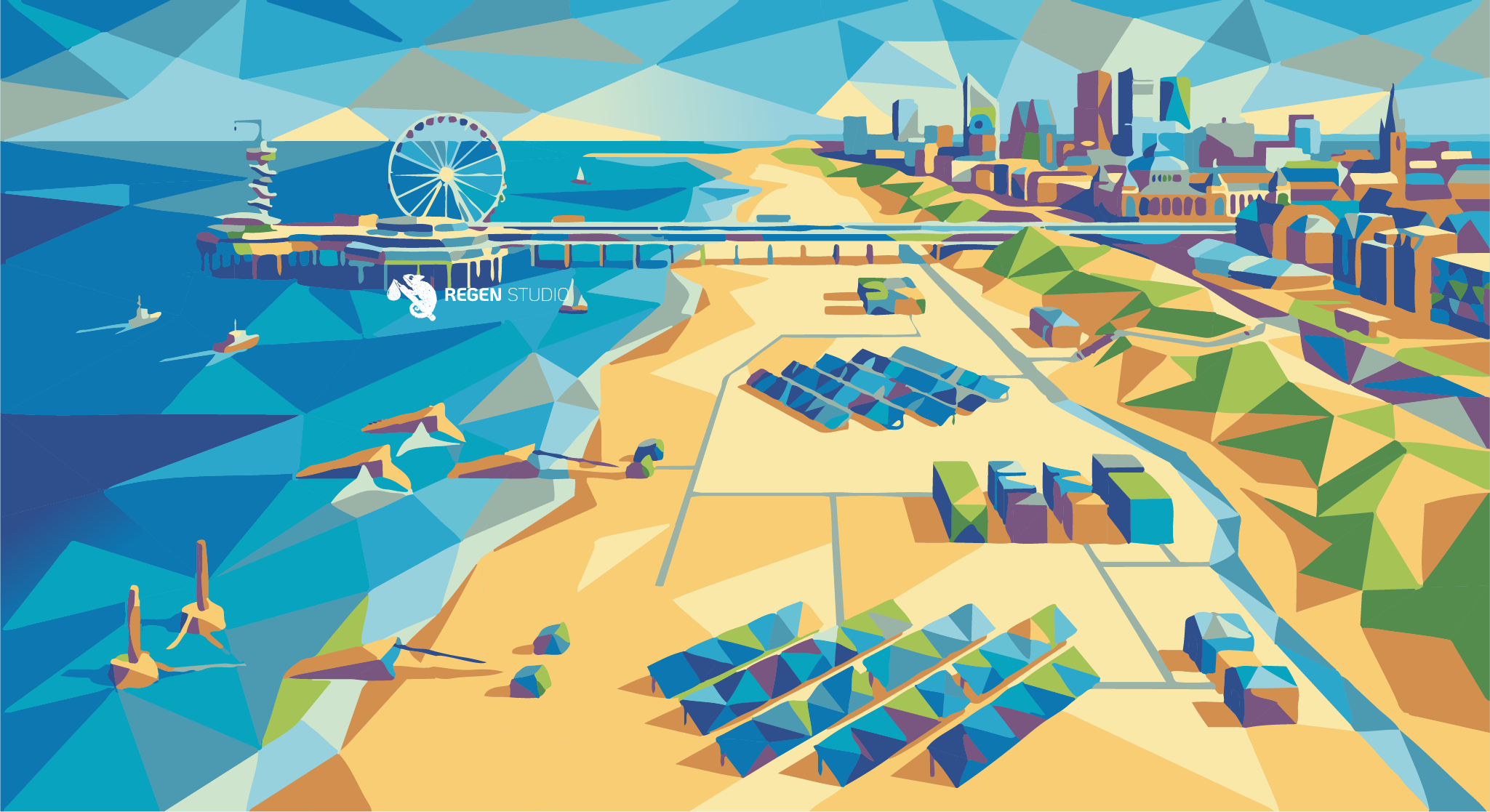
The Hague's smart microgrid at Scheveningen — known as Slim Strandnet — started in 2016, years before grid congestion became a national crisis. Today it runs on second-life EV batteries, circular solar panels, and an energy cooperative that puts energy justice at its core. Named top-3 government innovation in the Netherlands in 2025.
 in collaboration with
 &
&

In 2016, The Hague started building a community energy cooperative and smart microgrid at Scheveningen's northern harbour head — years before grid congestion became a national crisis in the Netherlands, and years before anyone was using the term netcongestie as a reason to block new connections. What drove it was not a crisis but a conviction: that the electricity system of the future would need to be smarter, more local, and more cooperative. By the time the grid problem arrived on the doorstep of Scheveningen, the solution was already being built.
That solution is Slim Strandnet (Dutch for Smart Beach Grid). Today it is a working 1-megawatt private microgrid running on solar energy, a second-life EV battery, open-source energy management software, and a cooperative governed jointly by the municipality and local beach entrepreneurs. In 2025 it was named one of the top 3 government innovations in the Netherlands, out of 60 submissions to the annual Beste Overheidsinnovatie van het Jaar competition organised by the Association for Government Management (VOM).
Regen Studio's founder was the one who set this project in motion — initially in his role at the City of The Hague, where he was responsible for establishing Slim Strandnet as part of Living Lab Scheveningen. After founding Regen Studio, that involvement continued: coaching the team, providing advice on system design and governance, and supporting the project's ongoing development as it grew from concept to national recognition.
Grid Congestion in the Netherlands: Why Slim Strandnet Was Years Ahead
When people say the Dutch electricity grid is "full," they usually mean something more specific: administrative netcongestie. This is not a situation where the physical cables can carry no more electricity — the physical infrastructure often still has room. What is exhausted is the allocated capacity: the sum of all individual connection capacities that grid operators have committed to across their customers. When those commitments collectively exceed what the grid can guarantee to deliver simultaneously, the operator closes the area to new connections — even if, in practice, not everyone draws their maximum at the same moment.
This distinction matters, because it means the problem is partly one of system design and coordination, not purely one of hardware. Slim Strandnet addresses exactly that: by managing local energy flows intelligently, it reduces the peak demand placed on the public grid and therefore the allocated capacity that participants need to reserve.
The municipal harbour building at Scheveningen was the first to run directly into this problem — around 2021, when it needed to expand its connection and discovered the public grid could not accommodate it. The building's team reached out to the Slim Strandnet project to explore whether a connection to the private microgrid was possible. It was — and that became the proof of concept for using the smart grid as a structural alternative to public grid expansion.
The case of beach pavilion HITO was even more acute. HITO could not connect to the public grid at all: no capacity was available, and no timeline for reinforcement was in sight. Without a connection, the project simply could not proceed. Slim Strandnet became a lifeline — the only viable path to electricity for the new beach club. Without the cooperative microgrid, HITO would never have opened.
The result: 33% more efficient use of the local network, measured against an unmanaged setup. Grid congestion that would have blocked development was resolved not by waiting for infrastructure investment, but by designing smarter use of what was already there.
Three Principles: Decentral, Digital, Democratic
The project's design philosophy is captured in three words.
Decentral. The microgrid is a private low-voltage network, independent of the constrained public infrastructure. Energy generated at the northern harbour head — primarily by solar panels on kiosks along the renovated Noord- and Moralesboulevard and on structures at the pier — is consumed locally. What cannot be consumed immediately is stored in the battery. Only the surplus and deficit that cannot be handled locally flows to and from the public grid. This shrinks the peak footprint on the public network and reduces the allocated capacity participants need to reserve.
Digital. The coordination layer is built entirely on open-source technology. The energy management system (EMS), provided by OpenRemote and implemented by Kersten Techniek, monitors all assets in real time: solar inverters, the battery, EV charging stations, heat pumps, commercial freezers and refrigerators in the beach pavilions. It forecasts generation and consumption patterns, creates dynamic internal price signals that automatically shift flexible loads to off-peak periods, and offers surplus flexibility to grid operators via GOPACS — the national congestion management platform used by Stedin and TenneT. Because the software is fully open source, the model is freely replicable by any other municipality, housing corporation, or energy community in the Netherlands. Slim Strandnet also participates in U2Demo, a European research project involving 20 partners across 8 countries dedicated to developing open-source, decentralised, consumer-centric strategies for peer-to-peer energy trading and community energy systems.
Democratic. Slim Strandnet is not run by the municipality alone. A public-private energy cooperative (energiecoöperatie) was established, bringing the City of The Hague and the beach entrepreneurs together as equal partners who jointly govern the network. This cooperative decides collectively on energy sharing agreements, pricing, and investment priorities, and operates on a non-profit basis: any financial surplus is returned to participants or redirected to the community.
A Municipality Inside an Energy Cooperative: Why This Governance Model Is Unique
One of the most distinctive aspects of Slim Strandnet — and one that attracted significant attention from the Government Innovation jury — is that a Dutch municipality is participating as an equal member of an energy cooperative alongside private entrepreneurs. Local governments have rarely taken this role. Typically, municipalities set rules, grant permits, or fund infrastructure; they do not co-govern commercial operations alongside beach club owners on equal footing.
What makes this even more remarkable is the legal context of the beach clubs themselves. Scheveningen's beach pavilions carry the status of roerende goed — moveable property. Because they sit on the coastline, where the law requires that structures can be dismantled and removed if necessary, they are not classified as real estate in the conventional sense. This creates genuine legal complexity for any cooperative structure: how do you build a shared energy governance arrangement around participants whose core asset is legally defined as temporary? Slim Strandnet worked through this carefully, creating a cooperative model that is robust enough to function as a long-term institution while accommodating the moveable legal status of its entrepreneurial members. It is a governance design that other coastal and temporary-structure communities may need to replicate.
At Slim Strandnet, the City of The Hague sits in the same cooperative as Strandpaviljoen Aloha, The Shore, and HITO — with shared responsibilities, shared risks, and shared rewards. The jury of the Overheidsinnovatie van het Jaar competition explicitly described this as "a smart regional solution for a problem created at the national level," noting the voluntary participation of the beach entrepreneurs as a defining feature. It is a governance model that could become a template for energy communities across the Netherlands as the new Energy Act (Energiewet), which entered into force in January 2026, formally enables exactly this kind of energy sharing within public grids.
Six Innovations Under One Smart Grid Umbrella
Slim Strandnet is not a single technology but an umbrella for a cluster of interlocking innovations, each one testing a different dimension of what a smarter, more circular energy system can look like.
The Beach Battery — Built from Recycled EV Batteries
The most visually striking element of Slim Strandnet is the 360 kWh stationary battery (strandbatterij), constructed from battery cells harvested from end-of-life electric vehicles. EV batteries that are no longer suitable for automotive use — typically when they retain around 70–80% of their original capacity — still have substantial energy storage potential. Rather than recycling them immediately, Slim Strandnet gives them a productive second life in a stationary application.
The practical impact is significant. The battery can power a beach pavilion — including all its freezers, coolers, and lighting — for approximately two full days on stored solar energy. It enabled the BeachStadium ice rink to keep its ice frozen around the clock using only daytime solar generation. And when the Live on the Beach summer music festival — one of the largest beach festivals in the Netherlands — took place at Scheveningen, the entire event ran on sustainable energy from the grid rather than the diesel generators that have traditionally powered outdoor events. Approximately 3,500 kWh of renewable energy was consumed during that event alone.
Circular, Repairable Solar Panels
Conventional solar panels are difficult to repair: when a component fails, the entire panel is typically replaced and discarded. Slim Strandnet has piloted circular, demountable solar panels designed by Biosphere Solar, a Dutch startup whose panels can be taken apart, repaired at the component level, and reassembled — fundamentally changing the end-of-life economics of solar infrastructure. The City of The Hague is Biosphere Solar's launch customer, and the circular panels were shown to the public at the Open Energiedag in September 2025. This approach reduces both waste and the total lifecycle cost of solar generation, making it a natural fit for a project that holds circular economy principles at its core.
Smart EV Charging
EV charging stations are connected to the Slim Strandnet grid and managed by the energy management system. Rather than charging on demand — which would create peaks that stress the local network — the EMS schedules charging based on solar availability, battery state, and grid conditions. When solar output is high and demand is low, EV charging is brought forward. During peak demand periods, charging is delayed or reduced. Some vehicles also have the potential for bidirectional (V2G) charging, returning electricity to the grid during high-demand moments, further increasing the network's flexibility.
Sustainable Event Connection
A bookable event connection point was established at the BeachStadium and along the boulevard kiosks, accessible via stroomkaart.nl. Event organisers can now draw renewable electricity from the Slim Strandnet microgrid instead of renting diesel generators. This removes both the noise and the emissions that have historically accompanied large outdoor events on the Scheveningen beachfront — and it makes sustainable events commercially accessible, since booking grid power is significantly cheaper than generator hire.
Harbour Shore Power — Walstroom for Vessels
Slim Strandnet is extending its reach into the Scheveningen harbour with walstroom — shore power infrastructure that allows vessels moored in the harbour to connect to the electrical grid instead of running their diesel engines at berth. Ships and boats typically idle their engines to power onboard systems while docked; walstroom eliminates this source of noise, air pollution, and fuel consumption. Extending the Slim Strandnet's clean energy supply to the harbour waterfront is a natural expansion of the microgrid's logic: replace fossil fuels at the point of consumption, using locally generated renewable energy managed by a smart grid.
Energy Community Governance and Energy Justice
The cooperative governance model goes beyond operational efficiency. From the beginning, the ambition was clear: the revenues generated by the solar panels should not only benefit the cooperative's direct members. The original idea was to use a share of those revenues to purchase solar panels for residents who cannot afford to install them — democratising access to the energy transition for those who are most exposed to rising energy costs but least able to invest in solutions.
The first trial of this principle took the form of a direct cash contribution — a donation of the grid's initial financial proceeds to the local food bank (voedselbank), as a concrete first act of social solidarity. It was a proof of intent: that the cooperative's governance was designed to generate community benefit, not just operational efficiency.
The solution that is now emerging is more structural. The vision is a city-wide social energy cooperative — a larger umbrella organisation to which the Slim Strandnet cooperative could become a daughter cooperative. The model works like this: each local energy cooperative, through its governance design, builds in a financial contribution to the city-wide social cooperative. That cooperative then uses the pooled revenues to fund access to renewable energy for households that cannot participate directly — through solar panels, reduced tariffs, or other mechanisms. If local energy cooperatives across The Hague adopt this structure, the energy transition stops being something that benefits only those who can afford to own a roof. It becomes a system that works for everyone — and that pays for its own social dividend from within its own economic logic.
This is what the project means when it describes itself as building "a better and fairer energy system." The jury of the Overheidsinnovatie van het Jaar competition found this dimension compelling: Slim Strandnet is not just a technical solution to an administrative grid problem. It is an attempt to make the energy transition structurally just.

A Partnership Built on Shared Ambition — with Stedin and Kansen voor West
Stedin, the regional electricity distribution company, has been a structural partner in Slim Strandnet from the beginning — not merely a grid operator that the project works around, but a co-developer engaged in both the technical and the financial architecture of the project. Together with the City of The Hague, Stedin helped secure funding through Kansen voor West, the European Regional Development Fund (EFRO) programme for the western Netherlands. The project received €621,857 in EFRO funding as part of a total budget of €1.55 million, with the remainder co-financed by the public partners.
Stedin's involvement reflects a broader strategic choice: rather than simply building more cables to resolve grid congestion, the distribution company is actively co-investing in local smart grid solutions that reduce the need for reinforcement. Slim Strandnet is part of Stedin's own research and development agenda, and the company has signalled its intention to replicate the model's proven innovations in other low-voltage networks across the Netherlands. The walstroom harbour shore power expansion is one dimension of this partnership — applying the same logic of local renewable energy management to vessels in the harbour.
The Technical Architecture
The grid's technical backbone connects solar panels, the battery, EV chargers, heat pumps, and commercial refrigeration systems via a fibre-optic network to the OpenRemote EMS platform. The system operates on two levels: a district-level EMS that coordinates shared assets (the battery, the solar field, the event connection) and individual home-level management systems (HEMS) for each participating building. Each HEMS participates voluntarily within the cooperative's shared framework.
Forecasting models predict solar generation and demand by day type and season. Dynamic internal tariffs create automatic price signals: when energy is flowing from the local network to a building, the tariff differs from when a building is feeding surplus back into the cooperative. These signals incentivise participants to shift flexible loads — a beach pavilion's freezer cycle, a heat pump's run time, an EV charge session — without requiring manual intervention. The result is coordinated, grid-friendly behaviour that emerges from economic signals rather than commands.
Excess flexibility is offered to Stedin and TenneT through GOPACS, the national grid congestion management platform. When the national grid needs relief, Slim Strandnet's battery or flexible loads can respond — and the cooperative earns compensation for that service. The local microgrid thus participates in national grid stability, turning a neighbourhood energy community into an asset for the broader system.
A Top-3 Government Innovation in the Netherlands
In 2025, Slim Strandnet was nominated for the Beste Overheidsinnovatie van het Jaar (Best Government Innovation of the Year), the annual competition run by the Association for Government Management (VOM). From 60 submissions, 32 advanced to jury review. Slim Strandnet made the shortlist of 10 semi-finalists, then pitched in a Dragon's Den-style event in Utrecht on September 19, 2025, before being selected as one of three finalists.
The jury conducted a site visit to Scheveningen on October 1, 2025. The award ceremony was held at the Koninklijke Schouwburg (Royal Theatre) in The Hague on November 27, 2025. Slim Strandnet received an honourable top-3 position — recognised alongside the winner as one of the three best government innovations in the country.
The jury's description: "Het slimme, decentrale energienet. Een slimme regionale oplossing voor een probleem, dat op nationaal niveau is gecreëerd." — "The smart, decentralised energy network. A smart regional solution for a problem created at the national level." They highlighted the use of open-source technology and the voluntary involvement of beach entrepreneurs as defining characteristics.
The nomination was significant not only as recognition for the project, but as a broader signal: smart grid solutions, once considered a niche technical topic, have become essential responses to a national challenge. What Slim Strandnet understood in 2016, the Netherlands is still catching up to in 2025. The energy transition does not always require new infrastructure — sometimes it requires smarter design of what already exists.
Regen Studio's Role
Regen Studio's founder initiated Slim Strandnet during his tenure at the City of The Hague, where he was responsible for establishing the project within Living Lab Scheveningen. The conceptual design, the partnership architecture, and the three-word philosophy — Decentral, Digital, Democratic — trace their origins to that early work.
After founding Regen Studio, the connection to the project continued in a different form: coaching the municipal team, providing strategic and design advice, and supporting the project's evolution through successive phases of expansion. This is the kind of engagement that sits at the heart of what Regen Studio does — not parachuting in with ready-made solutions, but building capacity and direction alongside the people who carry the work forward.
The project is now a demonstration site visited by ministries, European delegations, and grid operators from across the Netherlands and beyond. In September 2025, 25 officials from the Dutch Ministry of Climate and Green Growth visited Scheveningen to see Slim Strandnet's flexible storage infrastructure firsthand. Stedin has announced plans to replicate the proven innovations in other low-voltage networks across the country.
What started as a forward-looking experiment on a Dutch beachfront in 2016 has become a reference point for what the energy transition looks like when it is done well: technically robust, open by design, governed democratically, and built with community benefit at its core.
Read more about how we design smart energy communities:

Interested in what smart energy communities could look like for your city, organisation, or neighbourhood? Get in touch to explore what is possible.