In The Hague's Vruchtenbuurt, two energy cooperatives and the municipality used a structured innovation process to untangle a complex challenge: how do you optimally use the electricity grid and public space when residents generate their own energy, share cars, and want a neighbourhood battery? This is the story of how Problem Analysis and Ideation turned a residents' dream into a concrete plan.
 in collaboration with
In the Vruchtenbuurt — a residential neighbourhood in The Hague — something unusual has been growing. Energy cooperative Sterk op Stroom, with over 200 members, operates a collective solar roof, runs a smart electricity network connecting approximately 30 homes, and has received an experimental regulation exemption under the Electricity Law allowing it to provide energy services to up to 10,000 households for ten years. Car-sharing cooperative Vruchtenbuurt Deelt runs four shared electric vehicles. Together, they had an idea: what if you combined locally generated solar energy, smart charging, shared mobility, and a neighbourhood battery into one integrated system — a smart charging plaza?
The municipality's Mobility department picked up the initiative and, together with the Expertisecentrum Digitale Innovatie & Smart Cities (EC-DISC), proposed following the municipal digital innovation process — a structured eight-phase framework designed by Regen Studio specifically for government innovation contexts. This blog tells the story of the first two phases: Problem Analysis and Ideation.
The innovation process used in this project:

Phase 1: Problem Analysis — Mapping a System of 30 Interconnected Problems
The project started on 2 August 2023, when EC-DISC and the Mobility department ran a QuickScan to assess whether the challenge met the conditions for the innovation process. It did — and Phase 1 began.
What sounds like a simple idea — "a smart charging plaza" — turned out to sit at the intersection of energy policy, spatial planning, grid management, mobility strategy, community governance, and legal frameworks. Through a series of structured workshops with the municipality, both cooperatives, and Haagse Hogeschool, the team mapped the full problem system.
Workshop 1a: The Problem System
Using a Symptom Tree and a Values Canvas, the group surfaced and connected 30 distinct problem elements. These were digitised and visualised as a network of causal relationships. The problems clustered into seven themes:
- Space: Public space dominated by cars, high parking pressure, underground infrastructure congestion, standalone charging poles that don't invite collective behaviour
- Smart grid management: Grid not optimally used, smart charging insufficiently deployed, simultaneity of generation and consumption misaligned, challenge of realising local energy storage
- Local ownership: Challenge of shaping exploitation and ownership of local projects, energy transition not proceeding fairly, risk of state aid implications
- Social challenges: Emerging resistance against charging spots, resistance against shared car privileges, individualism in charging behaviour
- Innovation with residents: Need for a physical innovation space for grid-conscious charging, residents wanting room to experiment, challenge of sustained engagement
- Legal: Concession conflicts with pilots, net metering regulation disappearing, energy sharing without storage insufficient
- Climate: We seem to not be meeting climate goals
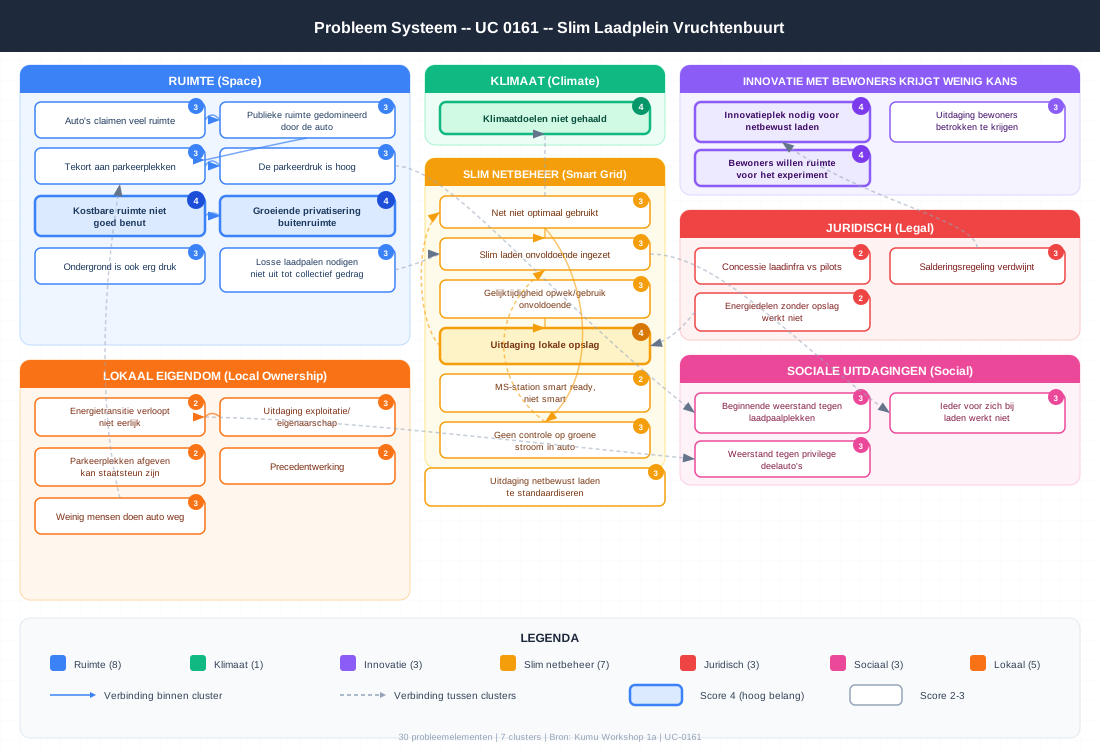
Six problems scored highest (score 4 — most critical):
- An innovation location is needed for grid-conscious charging in The Hague
- Residents want space for the experiment
- We seem to not be meeting climate goals
- Realising local storage is a challenge
- Growing privatisation of outdoor space
- Valuable space is not well utilised
Workshop 1b: Focus, Hypothesis & Stakeholder Mapping
From this system, the team distilled a single focus statement that carried consensus across all stakeholders:
The local electricity grid and outdoor space are not being optimally used.
The hypothesis that followed: We believe that when the electricity grid and public space are better utilised, this can help combat climate change and achieve our goals — and we think that a residents' initiative for a smart charging plaza with shared cars will help.
The stakeholder mapping identified over 40 organisations with a stake in the project — from the Dutch Authority for Consumers & Markets and Stedin (grid operator) to local shopkeepers and national bodies like the National Charging Infrastructure Agenda. Key internal stakeholders spanned six municipal departments, each with different levels of influence and interest.
Problem Characteristics
The structured analysis classified the challenge as:
In other words: a complex, multi-year, inter-disciplinary challenge that crosses physical and digital boundaries, demands co-ownership from residents, and has national-scale implications for how the Netherlands handles grid congestion and shared mobility.
The Synergy Hackathon (February 2024)
Rather than a standard co-sensing session, the team chose to combine deepening with ideation through a three-day Synergy Hackathon (1–3 February 2024). Students from TU Delft and Haagse Hogeschool, professionals from three municipalities (The Hague, Utrecht, and Gouda), energy companies, and Vruchtenbuurt residents worked together on the challenge. EC-DISC participated by leveraging Utrecht's lead role and Gouda's shared interest in smart charging.
The hackathon produced a critical conceptual shift. What started as a charging plaza for cars evolved into a charging plaza for people — a system diagram connecting wind and solar generation to local consumption, congestion management, an ICT control platform, data governance, energy cooperatives, local businesses, a neighbourhood battery, a medium-voltage station, vehicle-to-grid (V2G) charging, and even a public transport connection.
Key questions crystallised around governance and ownership: Who owns the generated energy? Who controls the shared charging infrastructure? Who has a say in how the neighbourhood battery operates? How are profits distributed? These are not technical questions — they are community design challenges.
Phase 2: Ideation — From Charging Plaza to Charging Street
As the Ideation workshops progressed, the team hit a naming problem. The Dutch word for "plaza" carried associations of playing, green spaces, and hanging out — expectations the project couldn't deliver, since the actual intervention involved smart charging poles and shared cars on a street. The team made a deliberate choice:
The Smart Charging Plaza becomes The Smart Charging Street.
The new name refocused the project on what it actually is: a street-level integration of smart charging, energy sharing, energy storage, and shared mobility.
Three Parallel Tracks
The Smart Charging Street proved too complex to prototype as a single concept. The team split it into three parallel tracks, each taken forward by a dedicated working group:
- The Group Contract: Working out the agreements between all parties — municipality, cooperatives, grid operator, university — defining who realises, manages, maintains, and operates the smart charging street. Multiple contract scenarios were developed as prototypes.
- Smart Shared Charging Poles: Experimenting with charging poles connected to the neighbourhood's own energy generation. Data analysis by Haagse Hogeschool on the charging system between homes and poles — priority allocation, peak reduction measurement, payment systems, and bi-directional charging potential.
- Space-Friendly Storage: Market research on a neighbourhood battery combined with fast, hybrid, and bi-directional charging. As Sterk op Stroom's membership grows, so does its energy surplus — storage makes the whole system more robust.
Workshop Results: What the Neighbourhood Prioritised
Across the ideation workshops, 38 ideas were generated and scored by participants. The results revealed clear priorities:
Idea scores by theme (total points across all ideas):
The highest-scoring individual ideas included:
- A smart data system linking car lending with charging scheduling
- Fast charging linked to time windows and neighbourhood energy availability
- Bi-directional charging tied to fixed parking spots (V2G requires a stable connection)
- Short-term parking + fast charging combined at local shops
- Energy storage in heat (using heat pumps as flexible assets)
- Limiting parking of fully charged cars to free up charging spots
Neighbourhood Event: Sharing is the New Owning
In September 2024, Sterk op Stroom and Vruchtenbuurt Deelt organised a neighbourhood information event under the banner "Sharing is the New Owning". The event aimed to broaden support, recruit new cooperative members, and gauge the wider neighbourhood's appetite for energy sharing and shared mobility.
What Emerged: Key Results and Insights
After 14 months of structured work across Problem Analysis and Ideation, several concrete outcomes crystallised:
- A systems-level understanding of a challenge that initially looked like "just" a smart charging plaza. The 30-element problem system and its causal connections made visible what was at stake — and what would break if addressed in isolation.
- A renamed, refocused concept: from Charging Plaza to Charging Street, dropping misleading associations and grounding the project in its actual physical and functional context.
- Three prototypable tracks — Group Contract, Smart Charging Poles, and Space-Friendly Storage — each with defined stakeholders, information needs, and next steps.
- A governance framework beginning to take shape, centring the question of who owns, operates, and benefits from the system — the cooperative, the municipality, or a hybrid structure.
- Quantified community priorities: 38 ideas scored by participants, revealing mobility and grid congestion as the dominant concerns, with data management a close third.
- Cross-municipal learning: through the Synergy Hackathon with Utrecht and Gouda, the project connected to other smart charging initiatives and shared lessons on grid operator collaboration.
- An experimental regulation exemption in place: Sterk op Stroom's 10-year exemption under the Electricity Law provides a legal framework that most energy communities do not have — creating a rare opportunity for real experimentation.
What This Shows About Municipal Innovation
The Vruchtenbuurt project is a textbook case of what the innovation process was designed to handle: a challenge that arrives as a simple idea ("smart charging plaza"), but unfolds into a systemic problem touching multiple municipal departments, legal frameworks, market parties, and community dynamics. Without the structured approach of Problem Analysis and Ideation, the project might have jumped straight to installing charging poles — missing the governance questions, the spatial conflicts, the energy storage dimension, and the community ownership model that make or break a project like this.
The innovation process forced the team to slow down and map the problem before solving it. It required stakeholder mapping before stakeholder engagement. It demanded a hypothesis before a prototype. And it created the conditions for the project to evolve — from plaza to street, from single concept to three parallel tracks, from residents' idea to municipal-cooperative co-ownership.
The best urban innovations don't start with technology. They start with understanding the system well enough to know where technology can make a difference — and where governance, community design, and institutional change matter more.
The Core Team
Municipality of The Hague: Mobility department (project owner), EC-DISC (use case management), Charging Infrastructure team
Sterk op Stroom: Energy cooperative, 200+ members
Vruchtenbuurt Deelt: Car-sharing cooperative
Haagse Hogeschool: Future Urban Systems — data analysis and prognoses
Regen Studio: Innovation process design and coaching
Hazenberg Architecten BV: Spatial design and architecture
Interested in applying a structured innovation process to your own energy, mobility, or public space challenge? Get in touch — we'd love to explore what's possible.