
All products need a QR code on their packaging from 2028. Packaging needs a Digital Product Passport. Passports must carry packaging data. Three claims, all circulating since the Packaging Regulation became applicable on 12 August 2026, and none of them survives contact with the text. What PPWR does oblige is one shared data carrier where a product passport and packaging information meet.
Start with what the European Commission itself says. Its Digital Product Passport FAQ gives the Packaging Regulation a one-line status note: "Adopted. Labelling/data requirements apply from August 2028 or later, pending an implementing act."
In our work on Digital Product Passports we keep hearing that the PPWR QR code became mandatory in 2026. The one most companies are hearing about is voluntary. And while everyone falls over labels and data carriers, we are missing what this regulation achieved on the same day: an EU-wide ban on PFAS at or above three limit values in food-contact packaging, which needs no implementing act.
Three myths are doing the rounds. Each has a precise answer in the text.
All products need a QR code on their packaging from 2028.
The sorting QR is permissive drafting and carries no compliance date of its own. Four cases do compel a carrier, and none of their dates is unconditional: reusable packaging, substances of concern, the fallback where no label fits, and EPR identification if you identify at all.
Art 12(1) 3rd subpara · 12(2)–(3) · 12(1) 2nd subpara · 12(5) · 12(9)Packaging needs a Digital Product Passport.
PPWR creates no passport. Article 12 is a labelling regime, it never uses the term, and it contains no link to the EU DPP Registry.
Art 12 in fullProducts that need a Digital Product Passport also need to include packaging data points.
Nothing in PPWR adds packaging fields to another regime's passport; each passport carries what its own act requires. Where both exist, Art 12(5) makes them share one data carrier.
Art 12(5), final subparagraphMyth 1: all products need a QR code from 2028
Article 12 is titled "Labelling of packaging". Its first paragraph has four subparagraphs, and the third one settles the question:
"In addition to the harmonised label referred to in this paragraph, economic operators may place a QR code or other type of standardised, open, digital data carrier on the packaging that contains information on the destination of each separate component of the packaging in order to facilitate consumer sorting."
Regulation (EU) 2025/40, Article 12(1), third subparagraphTwo words carry the meaning. "May place" is permissive drafting, and "in addition to the harmonised label" makes the voluntary QR a supplement to a mandatory printed one. Add the QR and you still owe the label; skip it and you owe nothing extra.
So what is mandatory? Something physical: a harmonised label showing material composition, pictogram-based. Transport and deposit-return packaging are excluded, e-commerce packaging is carved explicitly back in, so a parcel shipper cannot treat its boxes as exempt.
Article 12 mentions a QR code eight times, and not one of those eight names it without an open alternative beside it. The obligation, where it exists, is to carry data. The QR code is one way to do it, and the one the drafters happened to name.
And the date is not what people quote either. Article 12(1) reads "from 12 August 2028 or 24 months from the date of entry into force of the implementing acts adopted pursuant to paragraphs 6 or 7 of this Article, whichever is the latest". That conditional is doing real work, because the acts do not exist. They were due on 12 August 2026, the day the Regulation became applicable, and had not appeared as at that date, which is worth re-checking against the Official Journal. The arithmetic is what matters: an act in force in December 2026 pushes the label to December 2028, and a slip into 2027 pushes it into 2029. Until it exists, no printer in Europe could produce a compliant sorting label.
None of which makes a flat "the QR is voluntary" headline safe. Article 12 compels a carrier in four places, and a company can fall into any of them without having planned for it. None of the four carries an unconditional date.
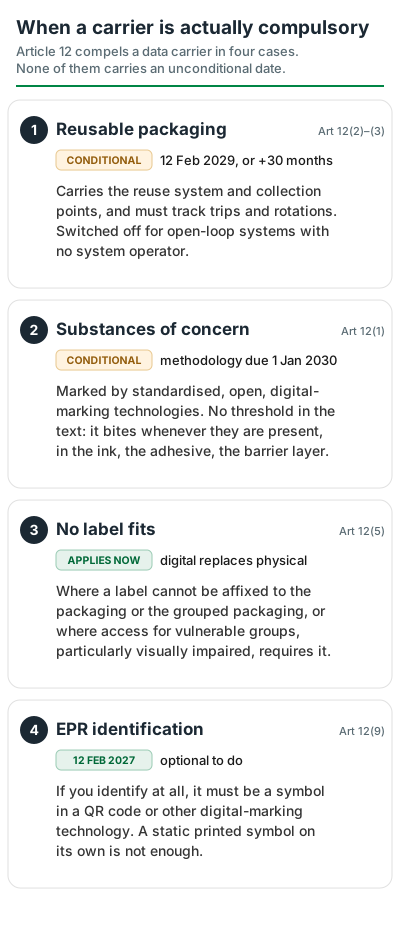
Reusable packaging must bear a label saying so, and the reuse system and its collection points must be reachable through a carrier that can track trips and rotations. The date is 12 February 2029, or 30 months from the Article 12(6) act, whichever is the latest. Article 12(3) carves out a derogation that is easy to miss: it does not apply to open loop systems with no system operator, so whether a refill scheme counts as a formal reuse system decides whether the obligation applies at all.
Packaging containing substances of concern "shall be marked by means of standardised, open, digital-marking technologies", under a methodology due by 1 January 2030 that must carry at least the name and concentration of each such substance in each material. This is the provision to watch, and almost nobody is preparing for it. PPWR does not define the term: Article 3 imports it from the Ecodesign Regulation, whose second limb catches any substance with a harmonised CLP classification in a listed hazard class. Antimony trioxide, the catalyst behind most virgin PET, is one. So are benzophenone in UV-cured inks and formaldehyde in adhesives. Note what is missing from Article 12(1): a threshold. No de minimis, no percentage, so read literally this stops being a niche case and starts looking like a sector-wide default. Article 5(2) requires the Commission, assisted by ECHA, to report by 31 December 2026 on which substances of concern are actually in packaging, and that report will size it.
A fallback where no label fits. Article 12(5) is easily missed: where a label cannot be affixed to the packaging and cannot be affixed to the grouped packaging either, or where non-discriminatory access to information for vulnerable groups, particularly visually impaired persons, requires it, the information "shall be provided via a single electronically readable code or other type of data carrier". That is the one case where digital replaces physical rather than supplementing it.
EPR identification. By 12 February 2027, packaging covered by an extended producer responsibility scheme may be identified across the territory where it applies. Identifying is optional, but a producer who does it has no choice of method: identification "shall be achieved only by means of a corresponding symbol in a QR code or other standardised, open, digital-marking technology". That rules out a plain static printed symbol on its own, which is why anyone printing a Green Dot or a national EPR mark should read it closely.
Myth 2: packaging needs a passport
Article 12 never uses the term "digital product passport". PPWR creates no passport, defines no data model, and contains no link to the EU Digital Product Passport Registry that went live in July 2026. What it creates is a labelling regime with an optional digital data carrier attached for consumer sorting.
The vocabulary is worth being pedantic about, because loose terminology is arguably what produced the myth. "Digital label" appears nowhere in PPWR. The label it makes mandatory in 2028 is a pictogram, affixed, printed or engraved. Digital delivery is the exception under Article 12(5), though Article 12(7) goes further: the methodology for identifying material composition, the content that label carries, is itself to work "by means of standardised, open, digital-marking technologies". Commentary that calls Article 12 a "digital labelling regime" fuses two separate things.
Myth 3: passports must carry packaging data
This one is the most consequential for anyone building a passport, because it changes the data model.
A sectoral Digital Product Passport carries what its own regulation tells it to carry. Nothing in PPWR reaches across and adds packaging fields to somebody else's passport. The Batteries Regulation (EU) 2023/1542 scopes its passport to the battery: identity, material composition, carbon footprint, due diligence, performance, circularity. Packaging is not a data category there. It appears only as a fallback surface under Article 13(7), where the battery is too small to mark and the labels go on the packaging instead. Somewhere to put the carrier, not something the passport describes.
The same holds for detergents under the Detergents and Surfactants Regulation, construction products under the Construction Products Regulation, and whatever the ESPR delegated acts specify. If a sectoral rule wants packaging data in its passport, it has to say so itself. A shampoo bottle can therefore be a product with a mandatory passport and packaging with an optional sorting label at once. Two payloads on two timetables, and for most consumer goods it is the passport regime, not PPWR, that forces a carrier onto the pack.
One QR to rule them all
Article 12(5) anticipates the collision between those two payloads and resolves it in a single sentence:
"Where Union law requires information on the packaged product to be provided via a data carrier, a single data carrier shall be used for providing the information required for the packaged product and for the packaging, and both shall be easily distinguishable."
Regulation (EU) 2025/40, Article 12(5), final subparagraphNote the verb: "shall", not "may". One code, both payloads, easily distinguishable. Recital 70 appears to go further, saying a product passport "should also be used" for this information, but recitals explain intent and create no obligation. The binding rule is Article 12(5), and it says something narrower.
For a detergent manufacturer this is the most useful sentence in Article 12. The passport carrier that becomes mandatory in September 2029 can carry the packaging sorting information too, so build one carrier with two cleanly separated payloads. We have written elsewhere about what makes those passports worth trusting, in our position paper, and about the registry underneath them.
What PPWR actually achieved on 12 August 2026
While the packaging industry rehearsed a QR obligation that does not exist, a real prohibition took effect on the same date, and it received a fraction of the attention.
From 12 August 2026, food-contact packaging cannot be placed on the EU market if it contains per- and polyfluorinated alkyl substances at or above three limit values in Article 5(5). The operator matters: a result of exactly 25 ppb is a breach, not a pass.
| Measure | Limit | Note |
|---|---|---|
| Any single PFAS, targeted analysis | 25 ppb | Polymeric PFAS excluded from quantification |
| Sum of PFAS, targeted analysis | 250 ppb | Where applicable with prior degradation of precursors; polymeric excluded |
| PFAS including polymeric PFAS | 50 ppm | Where total fluorine exceeds 50 mg/kg, the manufacturer, importer or downstream user must on request provide proof of the fluorine quantity, measured as content of either PFAS or non-PFAS |
Read the third row carefully. The 50 ppm applies to PFAS including polymeric PFAS; total fluorine above 50 mg/kg is the trigger for a documentation duty up the supply chain, not a limit. The distinction changes which test result puts a company in breach.
Article 5(4) adds a second live limit: lead, cadmium, mercury and hexavalent chromium together must not exceed 100 mg/kg, with its date coming from Article 71. Both belong in the Annex VII technical documentation.
The PFAS restriction needs no implementing act, no conditional date, no transition period. It is the clearest and most immediately enforceable obligation in the Regulation. The QR code, which absorbed most of the preparation effort, is voluntary. A company that spent 2026 sourcing data-carrier software and did not commission PFAS testing on its food-contact lines optimised for the wrong risk.
Why its dates keep moving
The QR myth is a symptom. PPWR's headline dates are mostly conditional, and the conditions have not been met. "Whichever is the latest" appears thirteen times across seven articles, and almost every instance ties a calendar date to an act the Commission has yet to adopt, then takes the later of the two.
A timeline presenting 2028 and 2030 as deadlines is presenting the earliest possible schedule as the actual one. Not everything moves: the 1 January 2038 grade-A-or-B floor has no conditional clause. Treat the rest as fixed and you schedule spend too early, then lose credibility the first time a date slips.
| Obligation | Earliest date | Condition | Article |
|---|---|---|---|
| PFAS limits in food-contact packaging | 12 Aug 2026 | Hard date No act required | 5(5) |
| Heavy metals, 100 mg/kg total | 12 Aug 2026 | Hard date Date from Art 71, not Art 5(4); glass and plastic crates keep derogations | 5(4) |
| EPR identification, digital marking only if used | 12 Feb 2027 | Hard date Optional to apply | 12(9) |
| Harmonised sorting label, printed | 12 Aug 2028 | Conditional or 24 months after the Art 12(6)/(7) acts | 12(1) |
| Waste-receptacle labels, Member State duty | 12 Aug 2028 | Conditional or 30 months after adoption of the Art 13(2) acts | 13(1) |
| Reusable packaging label plus tracking carrier | 12 Feb 2029 | Conditional or 30 months after the Art 12(6) act | 12(2) |
| Recycled content minimums, plastic parts | 1 Jan 2030 | Conditional or 3 years after the Art 7(8) act | 7(1) |
| Grade C floor, below it no market access | 1 Jan 2030 | Conditional or 24 months after the Art 6(4) acts | 6(3) |
| Recycled-at-scale requirement joins the grade | 1 Jan 2035 | Conditional or 5 years after the Art 6(5) acts | 6(2) |
| EPR fee modulation by recyclability grade | ~mid-2031 | Conditional 18 months after the Art 6(4) and 6(5) acts, read as the later of the two | 6(8) |
| Substances-of-concern marking methodology | 1 Jan 2030 | Hard date Commission duty to adopt | 12(7) |
| Grade A or B only | 1 Jan 2038 | Hard date in the text | 6(3) |
| Recycled content, second tier | 1 Jan 2040 | Hard date in the text | 7(2) |
Two rows carry most of the commercial weight. Article 6 grades recyclability as A, B or C per Table 3 of Annex II; there is no D and no E band. Below grade C means no market access from 1 January 2030, or 24 months after the Article 6(4) acts if later, and only A and B qualify from 2038. Fee modulation under Article 6(8) follows 18 months after the 6(4) and 6(5) acts, so on the Regulation's own deadlines it lands around mid-2031, after the market floor. The grade decides market access first and the invoice second.
What to do with the time this buys you
The work worth doing in 2026 is different from the work most companies were told to do.
Test your food-contact packaging for PFAS, and check the heavy-metals total while you are at it. These are the live obligations, with no transition period. Supplier self-declarations are a weak evidence base for an Annex VII file; certificates of analysis per packaging type, from an accredited laboratory, are the defensible version.
Design one carrier, not two. If a passport regime already applies, or will before 2030, Article 12(5) requires one carrier for both. Build it now and the packaging label becomes an increment, not a second project.
Work out whether you own reusable packaging in the legal sense, and map substances of concern in the packaging itself, the inks, adhesives and barrier layers. The first brings a tracking carrier from 12 February 2029, or 30 months after the Article 12(6) act if later. The second bites whenever they are present, and the methodology due by 1 January 2030 will want name and concentration per material per unit. That data takes years to assemble.
Settle the EPR identification question, which Article 12(9) frames as "by 12 February 2027" for anyone who identifies at all, and get recyclability graded. Grading is the urgent half: the grade-C floor arrives before fee modulation, so it is a market-access question first and a cost question second.
The uncomfortable part is that the delay is not good news. A specification arriving in late 2026 leaves roughly two years to redesign artwork across entire portfolios, and every month the Commission takes is a month removed from that window rather than added to it. The obligation moving right does not make it smaller. It compresses the runway while appearing to extend it.
One last piece of wording is worth carrying away. PPWR never says "passport" where it counts: the term appears twice in the whole Regulation, both times in recital 70 and never in an enacting article. If you are working out what this means for a specific portfolio, or how a packaging label should share a carrier with a passport you already have to build, get in touch.