
The EU's Ecodesign for Sustainable Products Regulation will require Digital Product Passports for a growing number of product categories. Most regional governments have no idea which businesses in their territory will be affected. Zuid-Holland decided to find out — and turned the insights into a funded support program.
The EU's Ecodesign for Sustainable Products Regulation (ESPR) will require Digital Product Passports for a growing number of product categories — starting with batteries in 2027, and expanding across 22 product groups under the ESPR for which delegated acts will be progressively adopted, plus several more from other EU regulations that also mandate Digital Product Passports — such as the Battery Regulation, the Construction Products Regulation, and the Detergents Regulation.
But most regional governments have no idea which businesses in their territory will be affected — or how to support them. One Dutch province decided to find out, and already turned the insights into a funded support program for local businesses.
Why This Matters for Regional Governments
The ESPR is European legislation, but its impact is local. Businesses are often unaware that these obligations are coming — and so are many regional governments. Awareness is growing year by year, but the gap between regulation and readiness remains wide.
The provinces and regions that act now will be able to support their businesses proactively — particularly SMEs, who are most likely to lack the resources and awareness to prepare for DPP obligations on their own. The ones that wait risk leaving them to figure it out alone.
Zuid-Holland: An Economic Powerhouse Takes the Lead
Zuid-Holland is home to Europe's largest port in Rotterdam, the seat of the Dutch government in The Hague, and world-class research universities in Delft and Leiden. It is one of the most economically dense regions in Europe. Yet even here, the province found that most businesses had little awareness of the obligations heading their way.
The province commissioned Regen Studio to take a data-driven first step. By cross-referencing Chamber of Commerce (KVK) registrations with the 22 ESPR product groups, the analysis mapped in which product groups Responsible Economic Operators are likely present in the province — as producers, importers, or authorised representatives — and in what estimated numbers.
The data to do this is not locked away. Chamber of Commerce registrations are publicly available across the Netherlands — and most EU countries maintain similar business registries. The method developed by Regen Studio cross-references these registrations with the ESPR product groups to estimate which product categories have significant business presence in a given region.
What the Data Reveals
The analysis did not identify individual businesses — the method does not allow for that. What it did reveal is in which ESPR product groups Responsible Economic Operators are likely present in the province, and in what estimated numbers. This gives the region the foundation to build a targeted support strategy — particularly aimed at SMEs, who are most likely to need help navigating these new obligations.
The biggest estimated volumes fall in the furniture and textile sectors. But the picture changes when you look at timing and geographic spread.
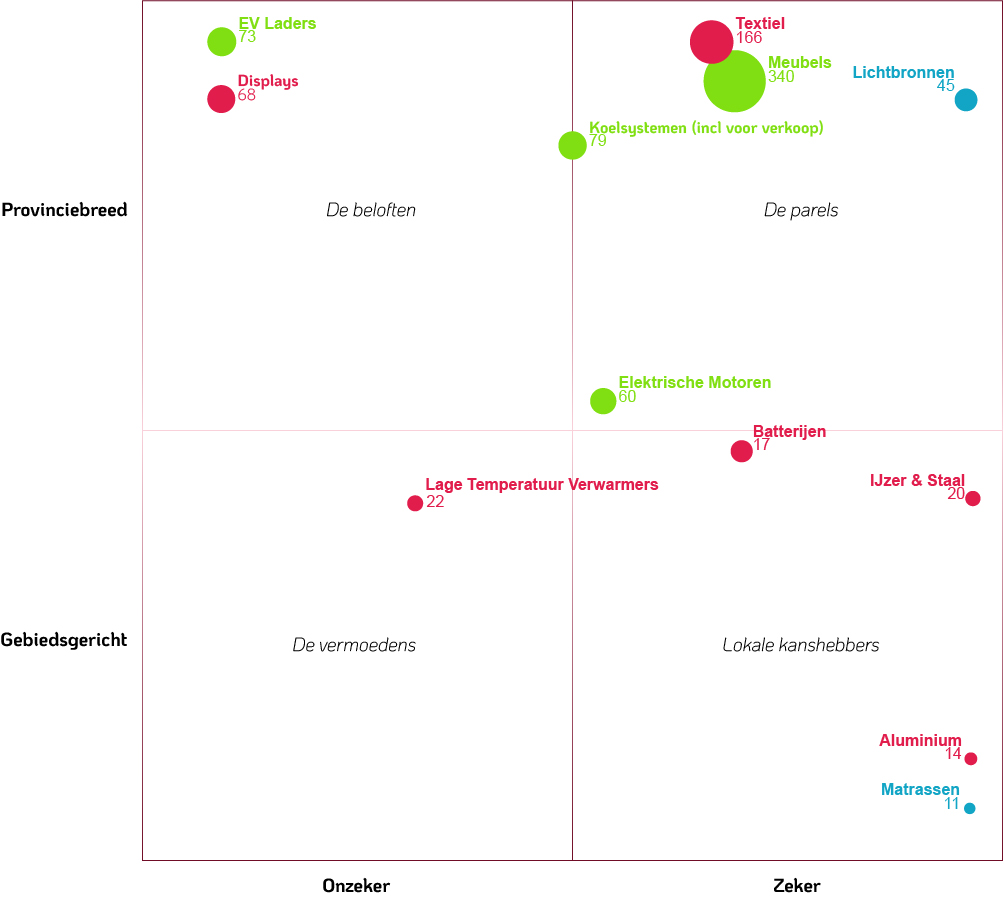
By plotting each product group on two axes — how certain the data is, and how widely the affected businesses are spread across the province — a strategic picture emerges. Product groups like textiles, furniture, and lighting sit in the top-right: high certainty, province-wide spread. These need broad support programs. Others, like aluminium and mattresses, are concentrated in specific areas — they need targeted, local interventions. And product groups in the left half of the quadrant still carry significant uncertainty — more investigation is needed before the right strategy can be designed.
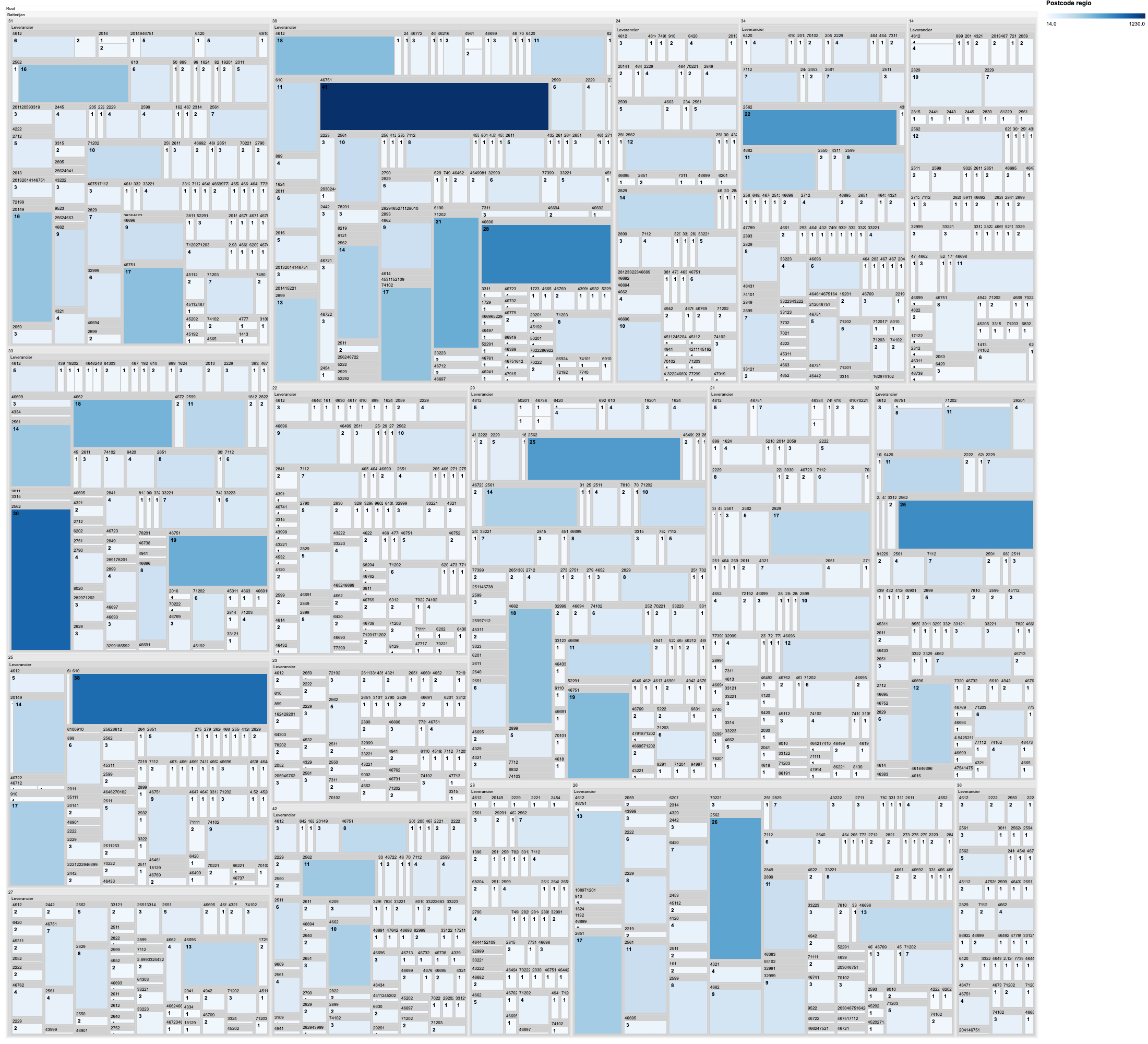
Geographically, every postal code area in the province has businesses that will be affected. But the distribution is uneven — some areas concentrate far more impact than others. And the analysis only covers producers — thousands more in supply chains, retail, distribution, and recycling will feel the ripple effects.
From Data to Action
The data analysis was designed as a first step — not an end in itself. Its purpose was to give the province the strategic foundation to act.
The province has also established a DPP Voucher program, funded through Kansen voor West III with European Regional Development Fund (EFRO) support. Through the voucher, SMEs in the region can access up to €30,000 in fully funded expert support to develop their Digital Product Passport strategy.
The ambition goes beyond compliance. Businesses that move early don't just meet regulatory requirements — they become frontrunners. A DPP forces you to map your materials, your supply chain, your product lifecycle. That exercise often reveals unexpected opportunities: new circular business models, material savings, or value in data that was never structured before. The SMEs that start now will be the ones discovering those opportunities first.
No Region Is an Island
Nine of the product groups analysed in Zuid-Holland also have significant business presence in neighbouring provinces. The ESPR does not stop at regional borders — and the response shouldn't either. Any region with a business registry and the right methodology can build this same picture for its own territory.
The question for every region is not whether the ESPR will affect its businesses — it will. The question is whether the region can still seize the opportunities of being an early mover, or whether it will be left scrambling for last-minute compliance when DPP obligations arrive.
Zuid-Holland, with its specific focus on SMEs, is working to make sure that all businesses in the region — not just the large corporates with dedicated compliance teams — can make the transition to these new rules. And more than that: that they can benefit from it. Because a Digital Product Passport is not just a regulatory burden. It is a structured window into your own product, your supply chain, and the circular opportunities hiding in your data.
Every region in Europe has the same starting point available: public business registry data, and a regulation that is coming whether you prepare or not. The method exists. The proof exists. The question is: who's next?
Regen Studio developed the data analysis methodology for Zuid-Holland and advises regional governments and businesses on ESPR readiness and Digital Product Passport strategy. Want to map the impact for your region, or explore how to support your local businesses? Get in touch to explore what is possible.