
The EU's Ecodesign for Sustainable Products Regulation is preparing its delegated act on textiles. With adoption expected around late 2026 or early 2027, what ecodesign requirements and DPP data should the industry prepare for?
The Ecodesign for Sustainable Products Regulation (ESPR) entered into force on 18 July 2024, replacing the earlier Ecodesign Directive. It gives the European Commission the power to set ecodesign requirements for products placed on the EU market, with only some explicit exemptions. Textiles are firmly at the top of the priority list. In this article, we take stock of where we are, what we expect, and what the textile industry should start preparing for.
Importantly, the Digital Product Passport — the digital backbone of the ESPR — is rapidly expanding beyond ecodesign alone. The Battery Regulation already mandates DPPs from February 2027, the proposed Toy Safety Regulation will replace declarations of conformity with DPPs, and the Detergents Regulation introduces similar digital information requirements. Even in agriculture, the EU is moving in this direction: the amended Fertilising Products Regulation (EU) 2024/2516 introduced digital labelling provisions for fertilisers, while the EU Deforestation Regulation relies on supply chain traceability that aligns closely with DPP principles. The EU's Single Market Strategy positions DPPs as essential infrastructure for making the internal market more efficient, with the Commission planning a progressive extension to nearly all physical consumer and industrial products by 2030. In short: the textile delegated act is not an isolated event but part of a much larger shift toward product-level digital transparency across the European economy.
Textiles as a Priority Product Category
On 16 April 2025, the European Commission published its first ESPR Working Plan for 2025–2030, designating textiles and apparel as one of the first product groups to receive ecodesign requirements. This was no surprise: the EU's Strategy for Sustainable and Circular Textiles had already identified the sector as having high potential for reducing environmental impact across durability, material efficiency, water use, waste generation, and energy consumption.
The working plan sets an indicative adoption date of 2027 for the textile delegated act — placing it alongside tyres in the first wave, ahead of furniture (2028) and mattresses (2029). But the path to adoption involves several intermediate steps that are already well underway.
Timeline of Expected Milestones
Timelines remain subject to change, and there is genuine uncertainty about several milestones. Below, we separate what is verifiable from what remains indicative, drawing on the European Commission's Green Forum, the Repass DPP timeline analysis, and Carbonfact's ESPR textile overview.
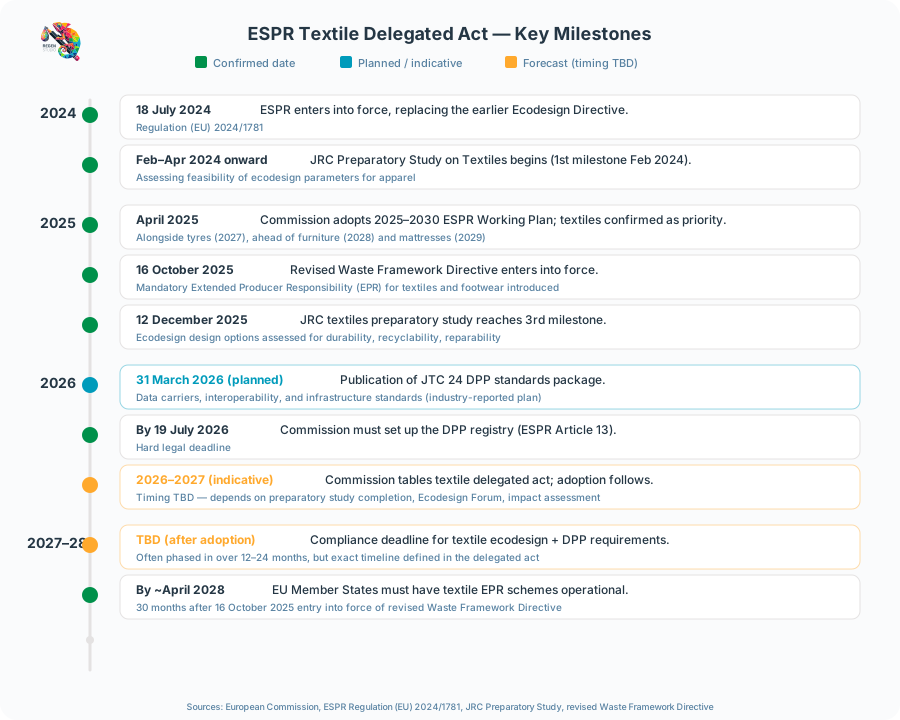
It should be noted that the ESPR Working Plan confirms textiles as a priority with an indicative adoption date of 2027, while industry analyses from Repass and Retraced anticipate the Commission proposal in late 2026 with formal adoption following shortly after. The compliance deadline will be defined in the delegated act itself and is often phased in over 12–24 months, but the exact timeline for textiles remains to be determined.
What the JRC Preparatory Study Tells Us
The JRC Preparatory Study on Textiles, which reached its third milestone in December 2025, is a key technical input informing the delegated act — alongside impact assessments, the Ecodesign Forum process, and Commission policy choices. The study assesses which ecodesign parameters are technically feasible and scalable, evaluating real-world data availability across brands and supply chains. Key findings so far include:
Durability is central, but complex. Raw materials and manufacturing represent 81–90% of the total environmental impact of a textile product. Extending service lifespan is therefore the single most impactful lever. However, the study acknowledges that durability is not purely a design property — consumer behaviour, perceived value, fit, and fashion trends all influence how long a product is actually used.
Recyclability faces fibre composition challenges. Blends of natural and chemical fibres are prevalent in apparel placed on the EU market — the JRC work cites 48–60% of products as blends — and current recycling systems still handle mono-material streams more readily than mixed-material ones. This makes it harder to forecast waste-stream composition and to scale fibre-to-fibre recycling, especially when identification, sorting, and the treatment of trims, coatings, and other "disruptors" remain non-trivial.
Reparability requirements are being explored but face hurdles. While repair-friendly design could extend product lifetimes, the study identifies several practical challenges in establishing binding reparability requirements for apparel.
Expected Ecodesign Requirements: An Educated Guess
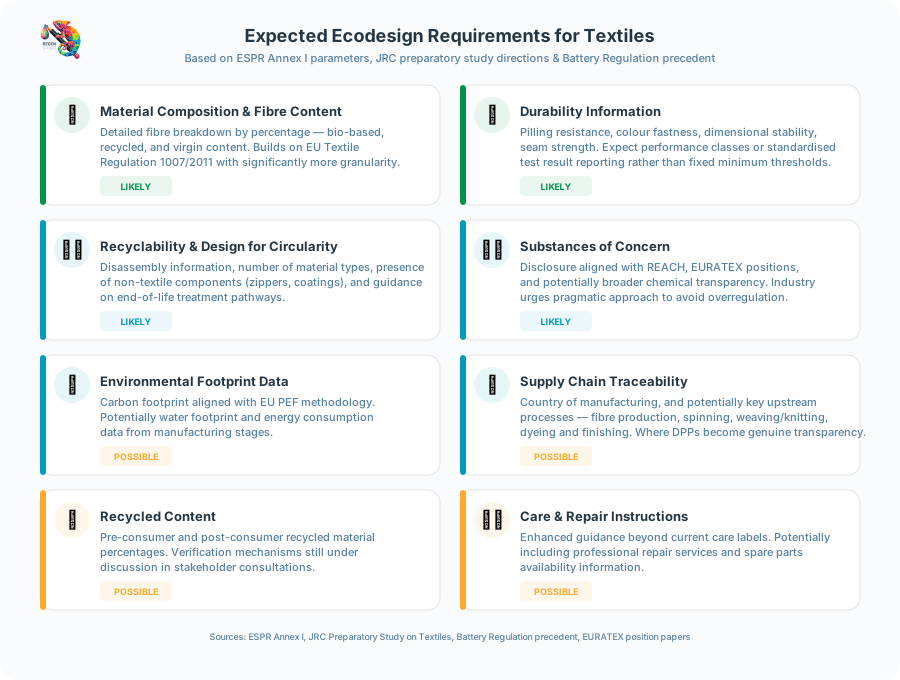
While the exact requirements will only be confirmed when the delegated act is published, the ESPR's Annex I defines a wide set of product parameters that delegated acts can translate into product-specific performance and information requirements. Based on the preparatory study's emerging directions, stakeholder consultations, and the precedent set by the Battery Regulation (which was the first product-specific DPP legislation), the most likely textiles requirements cluster around the following areas:
The Digital Product Passport for Textiles
The textile delegated act will not only set ecodesign performance requirements but will also specify what information must be made available through a Digital Product Passport (DPP). The DPP will serve as the digital vehicle for all the data points above — accessible to consumers, market surveillance authorities, recyclers, and other stakeholders through a data carrier (likely a QR code) on the product.
By July 2026, the EU must have a centralised DPP registry operational. The textile delegated act will then specify the exact mandatory data fields, access rights (which data is public, which is restricted to authorities), and technical standards for interoperability.
The scope of the delegated act is expected to cover garments — t-shirts, shirts, sweaters, jackets, trousers, dresses, underwear, socks — and accessories, while excluding smart textiles, personal protective equipment, medical devices, and raw materials.
See it in action
Want to see what a DPP system looks like?
Explore our interactive demo — tracking sustainable furniture from Brazilian forests through manufacturing, with UNTP verifiable credentials and ESPR compliance data.
Explore the DPP System Demo →The Broader Regulatory Landscape
The textile delegated act does not exist in isolation. Several parallel regulations will converge around the same timeline:
The revised Waste Framework Directive, which entered into force on 16 October 2025, requires all EU Member States to establish Extended Producer Responsibility schemes for textiles and footwear within 30 months. These EPR schemes will include eco-modulated fees — linking the cost producers pay to the sustainability characteristics of their products. This creates a direct financial incentive to design for durability and recyclability, complementing the ESPR's product requirements.
The destruction ban for unsold textiles takes effect for large enterprises from Q2 2026, and for medium-sized enterprises from 2030.
Together, these regulations create a comprehensive framework: the ESPR sets the product requirements and mandates DPPs, the EPR schemes create financial incentives, and the destruction ban addresses overproduction. For brands, this means that investing in product data infrastructure now is not optional — it is foundational.
What Should the Industry Do Now?
Even with the remaining uncertainty around exact requirements and timelines, there is enough clarity to act. Brands and manufacturers should begin mapping their supply chains to understand where data gaps exist. The most critical first step is building reliable traceability from fibre to finished product — something that many supply chains today simply cannot deliver.
Second, start collecting and structuring product data in a format that can feed into a DPP. Material composition, country of origin, chemical inputs, and durability test results should be treated as standard product data, not compliance afterthoughts.
Third, engage with the preparatory process. The European Commission's Green Forum and the ongoing JRC consultations are open to stakeholder input. Industry voices — particularly from smaller players who lack the resources of large brands — are needed to ensure the requirements are both ambitious and feasible.
At Regen Studio, we see these regulations not as a burden but as a catalyst for the kind of transparency and circularity that the textile industry urgently needs. The delegated act on textiles will be one of the most significant pieces of product sustainability legislation in a generation. Getting ahead of it is not just good compliance — it is good strategy.

Interested in how DPPs could transform Brazilian textiles specifically? Read our earlier piece: A Future-Ready Brazilian Textile Ecosystem with Digital Product Passports
Reach out at info@regenstudio.world to discuss how DPPs could work for your textile supply chain.