
The recast Construction Products Regulation (EU) 2024/3110 introduces a full Digital Product Passport framework in Chapter X. But when DPP obligations actually bite depends on harmonised standards and a delegated act that hasn't been adopted yet. Here's what the construction industry needs to know.
The Construction Products Regulation (EU) 2024/3110 — the recast of the original CPR 305/2011 — is one of the most significant pieces of EU internal market legislation for the construction sector in over a decade. Among its many innovations, it introduces a full Digital Product Passport (DPP) framework for construction products, set out in Chapter X (Articles 75–80). In this article, we walk through the legislative timeline, the DPP provisions, the critical role of harmonised standards, and what the Commission's Working Plan tells us about when different product families will actually be affected.
Looking for your product? Jump to the product family overview below to see estimated harmonised standard and DPP timelines for all 37 product families.
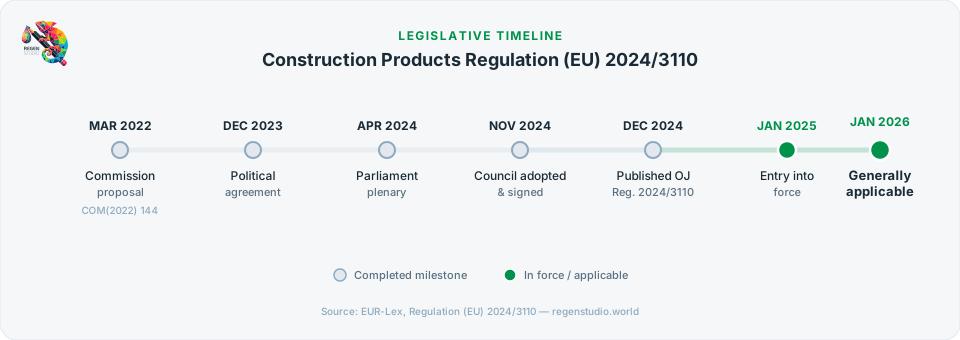
Legislative Timeline
The path from proposal to applicable regulation took nearly four years:
Where the DPP Lives in the CPR — Chapter X
The DPP provisions are concentrated in Chapter X of the regulation, spanning Articles 75 to 80. Unlike the ESPR, which delegates DPP details almost entirely to product-specific delegated acts, the CPR recast builds a substantial DPP framework directly into the regulation text:
- Article 75 — Establishes the DPP system. The Commission is empowered to adopt a delegated act setting out the technical design of the DPP system for construction products. In practice, it is expected that this delegated act will likely be adopted after the CEN/CENELEC JTC24 working groups have published the DPP technical standard — provided the construction sector deems it a suitable standard for its DPP requirements.
- Article 76 — Defines the minimum content that a DPP must contain: the declaration of performance and conformity (DoPC), safety information, relevant technical documentation, labels, and unique product identifiers.
- Articles 77–78 — Set out interoperability requirements, access rights, data security, and protections for trade secrets and confidential business information.
- Article 79 — Establishes the DPP registry: manufacturers must upload unique product identifiers and related data to this EU-level digital registry (shared with ESPR), expected operational in 2026. Article 80 — Provides for a publicly accessible web portal for searching and comparing DPP data, and sets out the operational timeline.
This is a notable design choice: the CPR builds on, and is designed to be interoperable with, the ESPR's horizontal DPP architecture — but it does so through a sector-specific regulation that reflects the particularities of construction products.
When Do DPP Obligations Actually Apply?
This is the central question for the industry — and the answer is more nuanced than a single date. DPP obligations for any product family depend on two conditions being met simultaneously:
- The product family must be covered by a new harmonised technical specification (HTS) under CPR 2024/3110 — replacing its current standard under CPR 305/2011.
- The Article 75 delegated act — which sets out the technical design of the DPP for construction products — must be in force. Per Article 75(8), DPP obligations apply 18 months after entry into force of this delegated act. Within that 18-month window, the technical infrastructure (built on the ESPR's horizontal DPP architecture — the EU registry, unique identifier scheme, and web portal) must become operational.
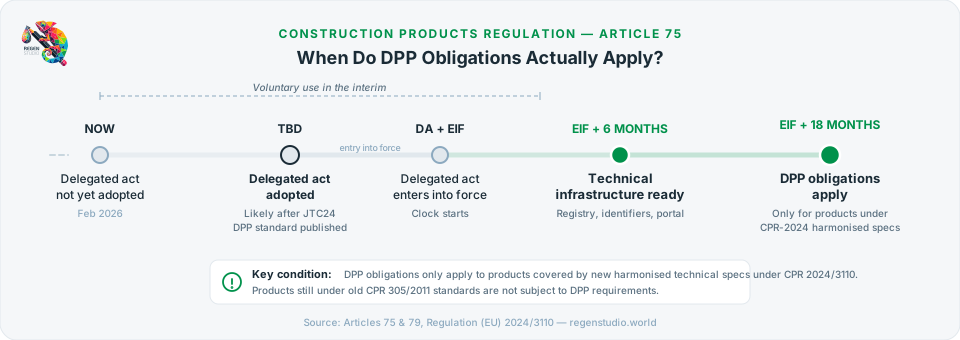
Until both conditions are satisfied, DPP use remains voluntary for that product family. The practical start date is always the later of the two: even if a product family's new harmonised standard is cited in the Official Journal, DPP obligations won't apply until the Article 75 delegated act has been in force long enough for the 18-month lead-in to elapse — and vice versa.
Looking for your product? Jump to the product family overview below to see estimated harmonised standard and DPP timelines for all 37 product families.
The Path from Preparatory Work to DPP
This is the process that will determine the real-world timeline for construction product DPPs. The CPR's Annex VII defines product families — broad groupings such as precast concrete, doors and windows, thermal insulation, and structural metallic products. Harmonised standards under the old CPR 305/2011 remain valid until they are formally withdrawn and replaced by new harmonised technical specifications (HTS) under CPR 2024/3110. Products migrate to the new regulatory regime family by family, as new standards are developed, adopted, and referenced in the Official Journal — and a DPP becomes mandatory for a given product only once its family has completed this transition and the Article 75 delegated act is in force.
The Commission's Working Plan (COM(2025) 772) tracks six milestones per product family, typically spanning 4.5–5.5 years from start to finish:
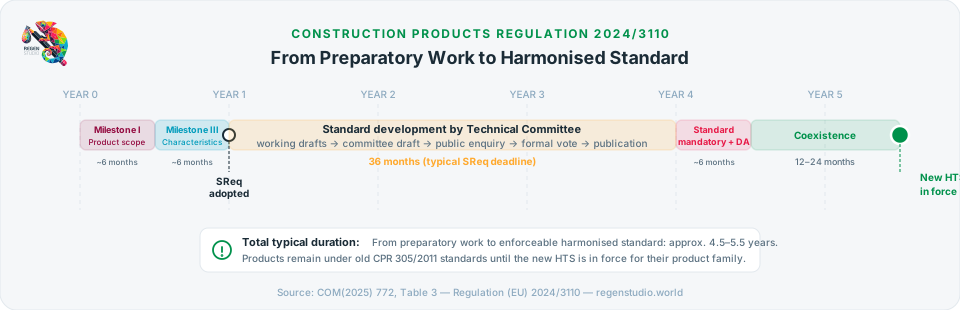
The adoption of a new harmonised technical specification under Regulation (EU) 2024/3110 follows six stages, as defined in the Commission's Working Plan (COM(2025) 772, Table 3):
- Milestone I — Product scope definition (~6 months) — The Commission defines the product scope for the family: which products fall within the family, what the regulatory boundaries are, and what existing standards need revision or replacement.
- Milestone III — Essential characteristics (~6 months) — The essential characteristics to be declared for products in the family are defined, along with the assessment methods and performance thresholds required under the new regulation.
- Standardisation request adopted — The Commission sends a formal request to CEN/CENELEC, specifying the scope, essential characteristics, and assessment methods required. The standardisation request sets a delivery deadline, typically 36 months.
- Standard development (36 months typical) — The responsible Technical Committee (TC) develops the harmonised technical specification through successive stages: working drafts, committee draft, public enquiry, formal vote, and publication.
- Standard mandatory + delegated act (~6 months) — The Commission assesses the delivered standard, and if satisfactory, adopts a delegated act making the standard mandatory and citing it in the Official Journal.
- Coexistence period (12–24 months) — The old and new standards coexist during a transition period, after which the old standard is withdrawn and only the new HTS applies.
Total typical duration from preparatory work to enforceable harmonised standard: approximately 4.5–5.5 years. Products remain under old CPR 305/2011 standards until the new HTS is in force for their product family.
The Commission's Table 3 reveals a continuous spectrum of progress across all 37 families. A critical legal nuance: DPP obligations under Chapter X are linked to the Declaration of Performance and Conformity (DoPC), which only applies to products covered by new harmonised technical specifications under CPR 2024/3110. Products still CE-marked under old harmonised standards cited under CPR 305/2011 — such as precast concrete (PCR, currently under EN 13369 etc.) and structural metallic products (SMP, currently under EN 1090-1) — continue using the old Declaration of Performance (DoP) and are not yet subject to DPP obligations. DPP for these families will only apply once new HTS under CPR 2024/3110 replaces their current standards. Based on the Working Plan milestones and typical standardisation timelines, our scenario estimate is ~2030–2031 for these earliest families — but this depends on standardisation requests being adopted on schedule and on CEN/CENELEC meeting delivery deadlines. For families with genuine new standard development under the new CPR (cement, doors and windows, thermal insulation), the scenario estimate is ~2029–2030. Later families without acquis work extend to ~2032–2034. These year-specific estimates are scenario assumptions, not regulatory commitments. Two conditions must converge: (1) the product family's new HTS must be in force, and (2) the Article 75 delegated act must have been adopted and the 18-month lead-in must have elapsed. The delegated act has not yet been adopted; based on the legislative programme, we estimate it will complete its lead-in by approximately 2028–2029, well before most product families' new HTS is ready. If that assumption holds, the harmonised standard is the binding constraint for the vast majority of families.
Two Routes to CE Marking — and Two Paths to DPP
A common misconception is that DPP obligations will activate for an entire product family at once. In practice, the rollout will be uneven within a product family because standardisation requests set deadlines at the level of individual deliverables and standards, not a single family-wide switch date. To understand why, it helps to know the two routes through which construction products reach CE marking today:
Route 1: Harmonised standards (hENs)
The majority of construction products are covered by harmonised European standards (hENs) — product specifications developed by CEN Technical Committees under a Commission mandate and cited in the Official Journal. Products covered by an hEN must be CE marked. Under the new CPR 2024/3110, each existing hEN will eventually be replaced by a new Harmonised Technical Specification (HTS). DPP obligations apply to a product once its specific HTS is in force — but different hENs within the same product family will be revised and adopted at different times. For example, in the Roof Coverings family (ROC), EN 490 (concrete tiles) could receive its new HTS before EN 1304 (clay tiles), meaning DPP for concrete roof tiles would activate before clay roof tiles — even though both belong to the same family.
Route 2: European Assessment Documents (EADs) and European Technical Assessments (ETAs)
When no harmonised standard exists for a product — typically innovative, niche, or novel products — manufacturers can obtain a European Technical Assessment (ETA) via an European Assessment Document (EAD) developed by EOTA. This is the CE marking route for products like green roof kits, FRP reinforcement bars, structural building kits, and many other innovations. Some product families rely entirely on EADs — Building Kits (KAS) has an estimated ~32 EADs and zero harmonised standards. Others use both routes: Roof Coverings (ROC) has approximately 21 hENs alongside ~32 EADs, and Products related to Concrete (CMG) has approximately 16 hENs plus ~19 EADs covering circular economy innovations like steel fibres recovered from end-of-life tyres and municipal waste incinerator bottom ash. (Note: per-family hEN and EAD counts are approximate, based on the nlfnorm.cz harmonised standards database and EOTA's EAD database, mapped to CPR Annex VII product families. Exact counts may vary as the Commission's official lists are updated.)
Under CPR 2024/3110, the EAD/ETA route has its own transition timeline:
- Old EADs (adopted under CPR 305/2011) remain valid for issuing ETAs until 9 January 2031 (five years from the Regulation's entry into force, per Article 95).
- ETAs issued under old EADs remain valid for CE marking until 9 January 2036 (ten years from entry into force).
- New EADs under CPR 2024/3110 must include environmental sustainability requirements (per Article 42): GWP declaration immediately upon adoption, core life cycle assessment indicators by 2029, and full LCA by 2031. (Note: the separate manufacturer declaration obligations under Article 15 follow a slightly later schedule — GWP from 8 January 2026, core indicators from 9 January 2030, all indicators from 9 January 2032.)
- New EADs have a 10-year validity period. ETAs issued under new EADs have no expiry.
DPP obligations for EAD/ETA products follow a similar logic: products placed on the market under new ETAs (issued against EADs adopted under CPR 2024/3110) will use the Declaration of Performance and Conformity (DoPC) and therefore fall under Chapter X DPP obligations. Products still operating under old ETAs (valid until 9 January 2036) are not subject to DPP — analogous to how products under old hENs use the old DoP and remain outside the DPP system.
The innovator's paradox
This two-route structure creates a counterintuitive outcome that the industry has not yet widely recognised: innovative products using the EAD/ETA route could face DPP obligations before mainstream products in the same family that are covered by harmonised standards — provided the Article 75 delegated act is in force and the manufacturer is using a new ETA issued under a CPR 2024/3110 EAD. Here is why.
In the new CPR architecture, the DoPC is a core element of what the DPP must contain, and the Declaration of Performance and Conformity (DoPC) is the key mechanism linking both routes to DPP obligations. Any product that issues a DoPC under CPR 2024/3110 falls within the scope of Chapter X. Both routes lead to a DoPC: a product covered by a new HTS issues one, and a product with a new ETA (against a CPR 2024/3110 EAD) issues one. Limited exemptions exist under Article 14 (e.g., individually manufactured products), but for mass-market construction products the DoPC — and therefore DPP — is the standard path.
The paradox arises from timing. EOTA can adopt a new EAD in roughly 12–18 months — the process involves a single Technical Assessment Body drafting the document and EOTA's technical board validating it. By contrast, developing a new HTS through CEN/CENELEC typically takes 36 months of TC work alone, preceded by 12+ months of preparatory milestones and followed by a coexistence period. This means a manufacturer of, say, an innovative green roof kit could obtain a new ETA under a CPR 2024/3110 EAD and be required to issue a DoPC — triggering DPP obligations — years before the mainstream clay or concrete roof tiles in the same family (ROC) have their harmonised standard replaced.
This is not a theoretical edge case. It affects every product family that has both hENs and EADs — which is the majority of the 37 families. Whether a product reaches CE marking through the hEN route or the EAD route, the transition timing to a DoPC — and therefore to DPP obligations — differs by route. The practical effect is that there is no way to indefinitely defer DPP: once a manufacturer's product falls under a new HTS or a new ETA under CPR 2024/3110, the DoPC requirement and the associated DPP obligation follow, subject to the Article 75 delegated act being in force and the 18-month lead-in having elapsed.
What the family-level estimates really mean
The DPP date estimates shown on each product family card below represent the envelope — the approximate date by which the last major products within that family are expected to be subject to DPP. In practice, individual products within a family will transition at different times depending on when their specific hEN is replaced by a new HTS, or when their EAD is adopted under the new CPR. Early products within a "~2032–2033" family could realistically see DPP obligations by 2030–2031 if their particular standard is prioritised in the standardisation request.
The Commission's Working Plan (2026–2029)
In late 2025, the Commission published its Working Plan (COM(2025) 772) for the rollout of harmonised technical specifications under the recast CPR. Its Table 3 provides granular milestone dates for all 37 product families — from product scope definition through to the delegated act making each standard mandatory.
The 37 product families below are ordered by their estimated DPP obligation date — earliest first — based on the readiness of existing standards and the work of CEN/CENELEC technical committees. The DPP obligation estimates are derived from Table 3 milestone dates plus the coexistence period and the Article 75 delegated act timeline. The numbers (e.g. #1, #20) refer to the product family numbers assigned in the CPR's Annex VII — they are regulatory reference numbers, not a priority ranking:
Disclaimer: The CPR regulatory landscape is dynamic and at times opaque, making it difficult to be completely up to date or accurate. The information on this page is provided for informational purposes only and should not be considered legal advice. For critical decision-making, we recommend validating this information with legal experts, sector organisations, or the European Commission. If you see anything that should be improved or updated, please let us know through the form below.
 Precast Concrete Products
Annex VII #1 · PCR
CEN/TC 229
Precast Concrete Products
Annex VII #1 · PCR
CEN/TC 229
 Structural Metallic Products
Annex VII #20 · SMP
CEN/TC 135
Structural Metallic Products
Annex VII #20 · SMP
CEN/TC 135
 Cement & Building Limes
Annex VII #15 · CEM
CEN/TC 51
Cement & Building Limes
Annex VII #15 · CEM
CEN/TC 51
 Chimneys & Flues
Annex VII #6 · CHI
CEN/TC 166
Chimneys & Flues
Annex VII #6 · CHI
CEN/TC 166
 Road Construction
Annex VII #23 · RCP
CEN/TC 227
Road Construction
Annex VII #23 · RCP
CEN/TC 227
 Floorings
Annex VII #19 · FLO
CEN/TC 134
Floorings
Annex VII #19 · FLO
CEN/TC 134
 Building Kits & Prefab
Annex VII #34 · KAS
EOTA (EADs)
Building Kits & Prefab
Annex VII #34 · KAS
EOTA (EADs)
 Attached Ladders
Annex VII #36 · LAD
Attached Ladders
Annex VII #36 · LAD
 Reinforcing Steel
Annex VII #16 · RPS
CEN/TC 459/SC 4
Reinforcing Steel
Annex VII #16 · RPS
CEN/TC 459/SC 4
 Doors, Windows & Gates
Annex VII #2 · DWS
CEN/TC 33
Doors, Windows & Gates
Annex VII #2 · DWS
CEN/TC 33
 Thermal Insulation
Annex VII #4 · TIP
CEN/TC 88
Thermal Insulation
Annex VII #4 · TIP
CEN/TC 88
 Flat Glass Products
Annex VII #30 · GLA
CEN/TC 129
Flat Glass Products
Annex VII #30 · GLA
CEN/TC 129
 Structural Timber
Annex VII #13 · STP
CEN/TC 124
Structural Timber
Annex VII #13 · STP
CEN/TC 124
 Fixed Fire-Fighting
Annex VII #10 · FFF
CEN/TC 191
Fixed Fire-Fighting
Annex VII #10 · FFF
CEN/TC 191
 Wall & Ceiling Finishes
Annex VII #21 · WCF
CEN/TC 128
Wall & Ceiling Finishes
Annex VII #21 · WCF
CEN/TC 128
 Gypsum Products
Annex VII #7 · GYP
CEN/TC 241
Gypsum Products
Annex VII #7 · GYP
CEN/TC 241
 Structural Bearings
Annex VII #5 · SBE
CEN/TC 167
Structural Bearings
Annex VII #5 · SBE
CEN/TC 167
 Space Heating
Annex VII #27 · SHA
CEN/TC 130
Space Heating
Annex VII #27 · SHA
CEN/TC 130
 Roof Coverings
Annex VII #22 · ROC
CEN/TC 128
Roof Coverings
Annex VII #22 · ROC
CEN/TC 128
 Circulation Fixtures
Annex VII #12 · CIF
CEN/TC 226
Circulation Fixtures
Annex VII #12 · CIF
CEN/TC 226
 Concrete & Mortar
Annex VII #26 · CMG
CEN/TC 104
Concrete & Mortar
Annex VII #26 · CMG
CEN/TC 104
 Aggregates
Annex VII #24 · AGG
CEN/TC 154
Aggregates
Annex VII #24 · AGG
CEN/TC 154
 Curtain Walling
Annex VII #9 · CWP
CEN/TC 33 WG 6
Curtain Walling
Annex VII #9 · CWP
CEN/TC 33 WG 6
 Construction Adhesives
Annex VII #25 · ADH
CEN/TC 193
Construction Adhesives
Annex VII #25 · ADH
CEN/TC 193
 Sealants for Joints
Annex VII #32 · SEA
CEN/TC 349
Sealants for Joints
Annex VII #32 · SEA
CEN/TC 349
 Fire Protection
Annex VII #35 · FPP
CEN/TC 127
Fire Protection
Annex VII #35 · FPP
CEN/TC 127
 Masonry Products
Annex VII #17 · MAS
CEN/TC 125
Masonry Products
Annex VII #17 · MAS
CEN/TC 125
 Waste Water Engineering
Annex VII #18 · WWD
CEN/TC 165
Waste Water Engineering
Annex VII #18 · WWD
CEN/TC 165
 Fixings
Annex VII #33 · FIX
EOTA (ETAs)
Fixings
Annex VII #33 · FIX
EOTA (ETAs)
 Membranes
Annex VII #3 · MEM
CEN/TC 254
Membranes
Annex VII #3 · MEM
CEN/TC 254
 Geotextiles
Annex VII #8 · GEO
CEN/TC 189
Geotextiles
Annex VII #8 · GEO
CEN/TC 189
 Sanitary Appliances
Annex VII #11 · SAP
CEN/TC 163
Sanitary Appliances
Annex VII #11 · SAP
CEN/TC 163
 Pipes & Tanks
Annex VII #28 · PTA
CEN/TC 155
Pipes & Tanks
Annex VII #28 · PTA
CEN/TC 155
 Cables & Wires
Annex VII #31 · CAB
CLC/TC 20
Cables & Wires
Annex VII #31 · CAB
CLC/TC 20
 Wood Based Panels
Annex VII #14 · WBP
CEN/TC 112
Wood Based Panels
Annex VII #14 · WBP
CEN/TC 112
 Drinking Water Products
Annex VII #29 · DWP
Drinking Water Products
Annex VII #29 · DWP
 Decorative Paints
New family · DPW
CEN/TC 139
Decorative Paints
New family · DPW
CEN/TC 139
Explore our demos
Request access to our demos on Digital Product Passports and CPR
What the DPP Must Contain
Article 76 specifies the minimum information that must be accessible through a construction product's DPP:
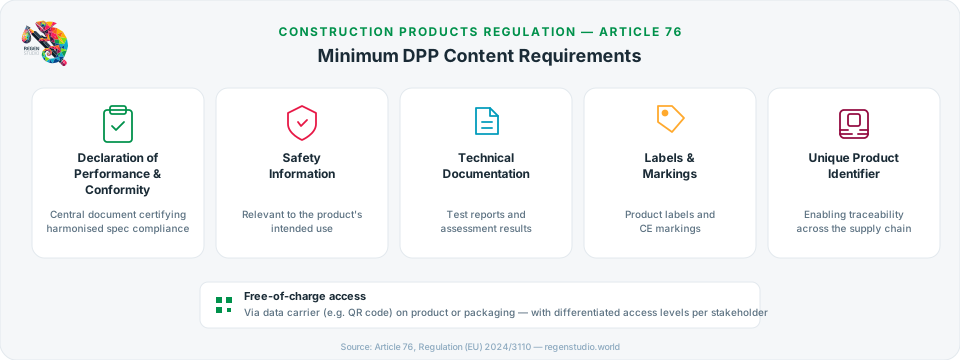
Under Article 76 of Regulation (EU) 2024/3110 (Construction Products Regulation), a Digital Product Passport must contain at minimum:
- Declaration of Performance and Conformity (DoPC) — the central document certifying that a product meets the applicable harmonised technical specifications.
- Safety Information — relevant to the product's intended use.
- Technical Documentation — including test reports and assessment results.
- Labels and Markings — product labels and CE markings.
- Unique Product Identifier — enabling traceability across the supply chain.
Access must be provided free of charge via a data carrier (e.g. QR code) on the product or packaging, with differentiated access levels per stakeholder.
Interoperability and Open Standards
Articles 77 and 78 contain unusually explicit requirements for the DPP's technical architecture. The regulation mandates:
- Open standards — data must be structured in open, machine-readable formats.
- No vendor lock-in — the DPP system must not tie manufacturers or other economic operators to proprietary platforms.
- Interoperability — the system must work across different software environments and be compatible with existing digital tools used in the construction sector, including Building Information Modelling (BIM) systems.
- Data security and trade secrets — access controls must protect confidential business information while ensuring that regulators and market surveillance authorities can access the data they need.
The emphasis on BIM compatibility is distinctive to the CPR and reflects the construction sector's existing digital infrastructure. It signals that the Commission sees the DPP not as a standalone compliance tool, but as a layer that integrates with how the industry already manages product data.
What Should the Industry Do Now?
Despite the uncertainty around exact dates, the direction is clear. Manufacturers and other economic operators in the construction sector should:
- Map your products to the working plan. Identify which Annex VII product families your products fall under and check where those families sit in the Commission's rollout timeline. Our CPR DPP Tracker can help →
- Start collecting and structuring product data. The DPP will require declarations of performance, safety information, technical documentation, and unique identifiers. Much of this data already exists but is often fragmented across different systems and formats.
- Engage with CEN/CENELEC. If your product family's standardisation request has been adopted or is in preparation, the standards development process is already underway. Industry input — particularly from SMEs — is critical to ensuring the resulting specifications are both ambitious and workable.
- Build DPP-ready data infrastructure. The regulation's emphasis on open standards, machine-readable formats, and BIM compatibility means that proprietary, siloed product data systems will not meet the requirements. Start investing in interoperable digital product data now.
The CPR recast represents a generational shift in how construction products are documented, tracked, and verified across the EU market. The DPP is not an add-on — it is a core part of the new regulatory architecture. Getting ahead of it is not just good compliance; it is a competitive advantage.