
Municipal digital innovation requires a process built for government — one that accounts for procurement rules, GDPR obligations, political cycles, and the need to transfer ownership to a team that will maintain and scale what was built. Regen Studio designed exactly that for The Hague's EC-DISC. The CIO of the Information & Automation department formally adopted it as departmental policy. Here is how it works — and how to engage it.
 in collaboration with
 &
&

Not all innovation processes are equal. A methodology designed for a startup — where speed is everything, stakeholders are few, and regulation is secondary — cannot simply be transplanted into a municipal context. When a city department runs an innovation project, it operates in a world of procurement rules, democratic accountability, GDPR obligations, departmental governance, political cycles, and the expectation that whatever is built must be maintained, reported on, and eventually owned by an organisation not always ready for change.
Regen Studio designed a custom eight-phase innovation process specifically for that context — developed for The City of The Hague's Expertisecentrum Digitale Innovatie & Smart Cities (EC-DISC) and Living Lab Scheveningen, the city's living laboratory for testing and scaling urban digital innovations. The process has since been formally adopted as departmental policy: the CIO of the Information & Automation department decided that digital innovation projects across the department follow this framework. A consultancy output became institutional infrastructure.
Built for Government — Not Startups
Design thinking, lean startup, double diamond — the private sector has produced a wealth of innovation methodologies. They are genuinely valuable, but they carry assumptions that do not translate cleanly into the public sector. In a city department, a prototype cannot skip a privacy impact assessment. Suppliers must be selected through a transparent procurement process. Stakeholders include city councillors, departmental directors, legal teams, and the public — not just end users. Political cycles affect timelines and risk appetite. And adoption requires not just a good product, but an organisation ready to maintain it.
The process Regen Studio designed for EC-DISC takes all of this as its starting point — not as obstacles to work around, but as design constraints that shape every phase. The result is a process that is rigorous enough to satisfy a municipal governance framework and flexible enough to accommodate the genuine unpredictability of innovation work.
Eight Phases — From Problem to Adoption
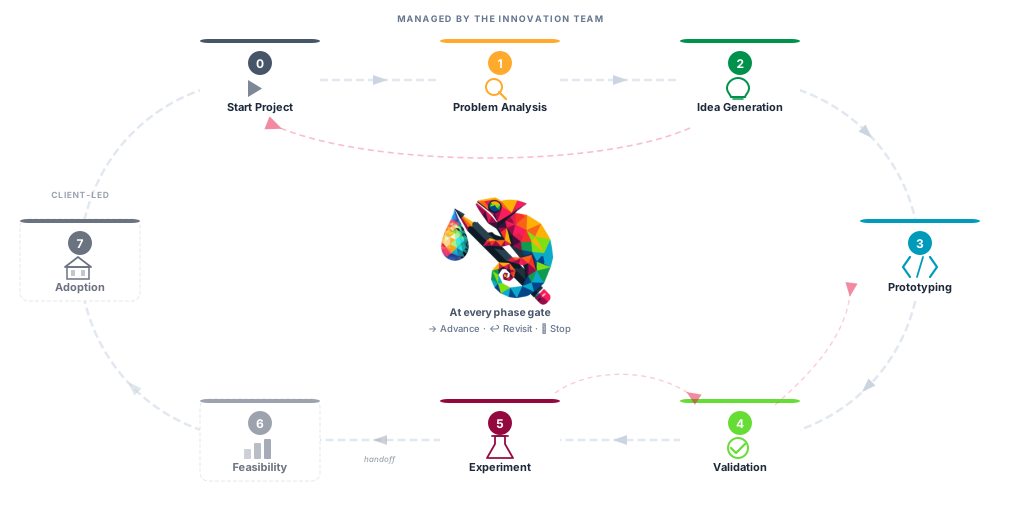
The process runs from a problem that has not yet been defined to a solution that an organisation owns and operates independently. Phases 0–5 are under the project management of the innovation team. From phase 6, ownership has transferred to the client organisation — the municipal department or innovation team that will take the project forward. At the end of every phase, the team makes an explicit decision: go forward, step back and revisit with new insights, or stop.
Phase 0 — Start Project. Before any innovation work begins, a project start template is filled in, that outlines all the conditions for having a successful innovation project, such as is there a clear problem domain owner, the willingness to learn and the possibility to fail, if there is enough financial backing or capacity of stakeholders to participate. If unfavourable conditions are present, the project is advised to find another way of continuing.
Phase 1 — Problem Analysis. The hardest part of innovation is rarely the solution — it is defining the problem accurately. This phase runs structured workshops with stakeholders and end users to surface root causes rather than surface symptoms, build a shared problem map (using network visualisation tools), and challenge the assumptions the team arrived with. The output is a validated problem definition, a stakeholder map, and a set of learning goals that guide the phases ahead. Six situational deepening options are available, from co-sensing workshops with communities to data analysis, UX research, and in-depth interviews.
Phase 2 — Idea Generation. With a clear problem definition, the team generates and selects solution directions. Ideation sessions bring together a diverse group of stakeholders to produce concrete proposals, visualised in an idea matrix. Each idea passes through an Innovation Quickscan — structured input from all relevant expertise centres across the organisation (privacy, security, data & AI, legal, procurement, information management) — and an ethics workshop before a solution direction is chosen. Ten situational deepening paths are available, including design sprints, hackathons, Startup in Residence challenges, and student project partnerships.
Phase 3 — Prototyping. The chosen idea is turned into something testable as quickly as possible. Suppliers are selected through a transparent process — minimum three quotes, drawing on channels including Impact City, Startup in Residence, The Hague Tech, and YES!Delft. Design sessions with real users generate personas, user journeys, and system requirements. The prototype is built, tested, and iterated — all within a framework that uses Technology Readiness Level to set realistic expectations with management. A visitor counting system in a municipal building, for example, requires a very different prototyping approach than a sensor communication network in public space.
Phase 4 — Validation. This is where municipal-specific complexity concentrates. The prototype is made experiment-ready through a structured validation checklist: storyboard, process and data flow, high-level architecture, DPIA, BIO security baseline, ethics audit, impact measurement design, ecosystem value map, management information plan, and permits for public space where required. Every relevant expertise centre in the organisation is formally involved. This is not bureaucracy — it is what makes the difference between an experiment that is trusted by the organisation and one that gets cancelled at the last moment for a reason that could have been resolved six months earlier.
Phase 5 — Experiment. The validated prototype runs in the field. The experiment plan defines all work packages, responsibilities, budget, timeline, and impact indicators. Communication — to the public, to internal stakeholders, to political leadership — is a formal work package in every experiment, not an afterthought. Impact measurement is executed and evaluated. At the close of the experiment, a full results report is produced and scenarios for adoption are defined. This is the final phase in which the Digital Innovation team is in the lead: from here, the project belongs to the team that will run and maintain it.
Phases 6 & 7 — Feasibility and Adoption. These phases are intentionally left open. No prescriptive steps — every organisation needs to determine for itself how to take a successful experiment into structural operation. The innovation team's role shifts to advisory: guiding the problem owners rather than directing them.
The Architecture of Every Phase
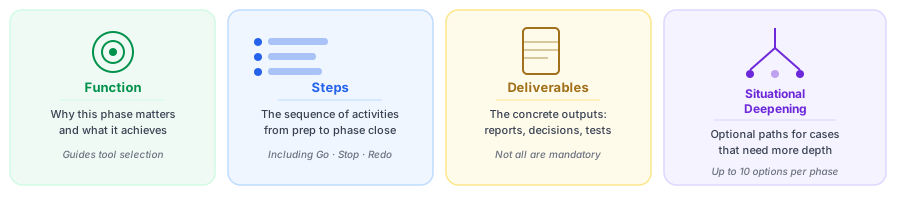
What makes the process coherent across eight diverse phases is a shared internal architecture. Every phase breaks down into four elements: its function (the purpose and goal — which also serves as the test for whether the tools you are choosing actually serve that goal), its steps (the sequence from preparation through closure, including the explicit Go / Stop / Redo decision), its deliverables (the concrete outputs — not all mandatory, but all justified), and a menu of situational deepening options for cases that need more.
The situational deepening menus are one of the things that most distinguish this process from a rigid framework. Phase 1 offers six deepening paths. Phase 2 offers ten. The use case manager chooses from the menu based on what the specific project needs — and what it can be skipped without consequence. Innovation is not a checklist; this process is designed to be navigated, not merely followed.
The Quickscan: Involving the Whole Organisation
One of the most operationally distinctive elements is the Innovatie Quickscan — a structured process in which all relevant expertise centres in the organisation give their assessment of a proposed innovation before it proceeds to validation and experimentation. Privacy, security, data & AI, legal, procurement, information management, and archiving each contribute a paragraph: risks, trade-offs, showstoppers, and recommendations.
This serves two purposes. First, it uses the knowledge of each expertise centre to improve the solution and fit it within the boundaries of the organisation — preventing the scenario in which a project reaches the experiment phase only to discover an insurmountable legal or security objection. Second, it generates early buy-in and familiarity, so that projects have a better chance of being understood and adopted. By the time a project reaches the experiment phase, the key stakeholders are not encountering it for the first time.
Officially Adopted as Policy
The process was not simply delivered as a consultancy output. Following its development and application across a growing portfolio of use cases — from smart waste bin management (Mr. Fill) to sensor networks in public space, visitor counting systems in municipal buildings, and registration systems at Scheveningen harbour — the CIO and the Management Team of the Information & Automation department formally adopted the process as departmental policy. Digital innovation projects across the department follow this framework.
That decision transformed a methodology into institutional infrastructure. The process now survives beyond any individual project or team, and creates the conditions for consistent, rigorous, and replicable innovation practice across the department. It is also the foundation on which capacity development is built: use case managers learn the process by doing it, supported by templates, phase plans, and example cases that document what was learned.
The process, when applied well, can also become the basis for Innovation Management. Keeping track of the projects following the phases will generate insights in common bottlenecks, cross-over pain points, and allow innovation activities to become measurable. The prime unit of measure here should not be how many projects reach the final stage of adoption, although of course this is important. The most important unit of measure is passed time in being able to learn what works and what doesn't work, so that we can move on towards other potential solutions. A stop can be as valuable as a go, if it prevents loss of funds, capacity and time.
Phase 4 in Practice: The Energy Justice Case
The energy justice project — UC-0150, Energierechtsvaardigheid — illustrates what Phase 4 looks like when the validation work is complex. The project tested whether solar cooperative revenues from Living Lab Scheveningen's Slim Strandnet smart grid could be routed directly to households in need, reducing their energy bills without requiring them to join or invest in a cooperative. Regen Studio facilitated the validation phase: designing the impact measurement framework, navigating the legal complexity of the Dutch gift policy as it applied to welfare recipients, and building the privacy architecture through a proactive DPIA used as a design tool. Regen Studio then designed the full Phase 5 experiment plan. One of the outcomes was a policy revision at the municipality's department of social affairs — the gift rules were found to be too rigid for the energy transition's emerging social models, and this project made the case for change.

Every Phase as a Standalone Service
Regen Studio — Service Entry Points
Click any phase to view steps & deliverables
Start Project
Process setup & intake
Full processProblem Analysis
Workshops & mapping
StandaloneIdea Generation
Ideation & quickscan
StandalonePrototyping
Build & test
StandaloneValidation
Compliance & DPIA
StandaloneExperiment
Field test & impact
StandaloneFeasibility
Scale-up strategy
AdvisoryAdoption
Knowledge transfer
AdvisoryThe process was designed for EC-DISC, but the expertise behind it is available to any organisation navigating digital or social innovation. You do not have to be at the beginning to engage Regen Studio. If you are already mid-process — with a validated idea that needs a prototype, a prototype ready for validation, or an experiment that needs impact measurement design — we can step in at that phase and provide what is needed to move forward.
A full eight-phase engagement is also available for organisations that want to build their own innovation practice from scratch. In that case, the deliverable is not just a completed project — it is a process the organisation owns and can repeat, with templates, governance structures, and trained people to carry it.
For Other Cities
Living Lab Scheveningen was the original context. But the process was designed to be transferable. The problems it solves — how do you move from a poorly-defined problem to a validated, organisation-owned solution, within the constraints of a public-sector environment — are shared by municipal and regional government teams across Europe. The CIO adoption at The Hague's Information & Automation department is one proof point. The energy justice case is another. The smart city use cases that preceded them are more.
If you want to adapt this process for your own innovation team, run a specific phase with external facilitation, or build the institutional infrastructure for digital innovation from the ground up, learn more about our approach on our Innovation Services page.

Ready to move your innovation project forward — or to build the process that makes it repeatable? Get in touch to explore what is possible.